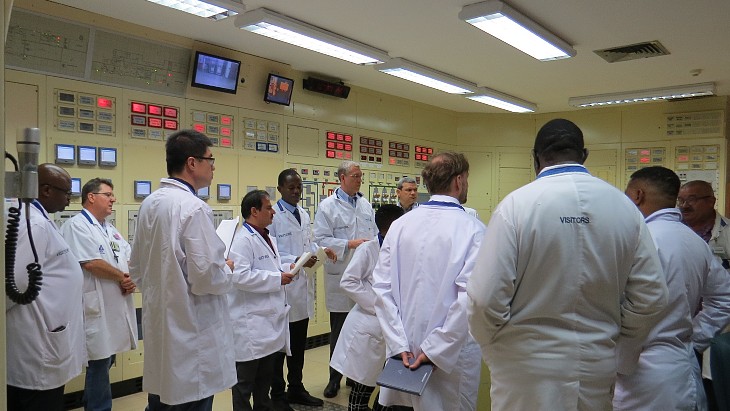
• Safety review completed at South African research reactor The five-day six-person Safety Review Mission on Ageing Management and Continued Safe Operation was at the invitation of the facility’s operator, the South African Nuclear Energy Corporation (Necsa) and was completed on 6 February. • Safari-1 is a tank-in-pool research reactor which reached first criticality in 1965 with a capacity of 6.67 MWt. • Over its 60 years of operation it has undergone various power uprates and been converted to use low-enriched uranium fuel and low-enriched uranium targets for isotope production. • Today, it has a licensed operating power of 20 MWt and is one of the world’s major commercial producers of medical and industrial radioisotopes. • It is also used for activation analyses, material modification (such as the neutron transmutation doping of silicon for the semi-conductor industry) and provides support services such as neutron radiography and neutron diffraction for both industry and research. • It is currently licensed to operate until 2030, but could be a sustainable operational irradiation facility beyond that date, pending an engineering assessment supported by an ageing management programme, Necsa has said.
Article Summaries:
- A five‑day Safety Review Mission on ageing management and continued safe operation of South Africa’s Safari‑1 research reactor concluded on 6 February. The IAEA‑led team praised the reactor’s strong safety culture and early engagement with regulators, but urged better resource allocation, systematic screening of ageing components, and formalised obsolescence programmes. Safari‑1, a 20 MWt tank‑in‑pool reactor first critical in 1965, is licensed to 2030 and may continue beyond that with an engineering assessment. A follow‑up review is planned for 2028, while the cabinet approved a ZAR 1.2 billion budget for a new multipurpose reactor to replace Safari‑1.
Sources: