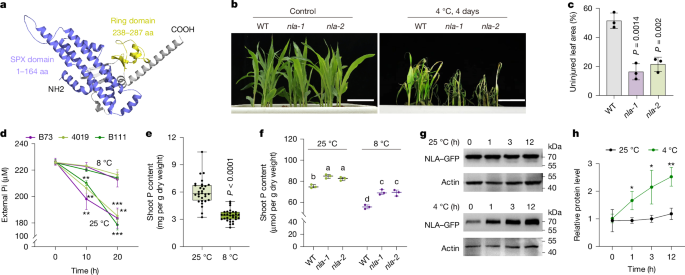
• Abstract Cold stress restricts plant growth and inorganic phosphate (Pi) uptake, reducing yield and increasing fertilizer demand1,2,3 • Enhancing both cold tolerance and phosphorus use efficiency (PUE) is crucial for sustainable crop productivity • Here we identify the SPX-domain-containing E3 ubiquitin ligase NITROGEN LIMITATION ADAPTATION (NLA) as a central regulator that links cold signalling to Pi homeostasis in maize (Zea mays L • Under cold conditions, NLA promotes the degradation of the transcriptional repressor JAZ11, activating jasmonate signalling to enhance cold tolerance; however, NLA also simultaneously represses Pi uptake, through inositol polyphosphate (InsP)-dependent ubiquitination of the Pi transporter PT4 • A ubiquitinome-informed genome-wide association study identified a natural PT4(K267A) (lysine-to-alanine substitution) variant that attenuates NLA-mediated degradation and increases Pi uptake in cold conditions • To overcome this nutrient-stress trade-off, we combined artificial-intelligence-guided structural modelling and ligand docking with genome editing to generate the nlaΔ12 allele, which encodes an NLA variant in which binding to InsP is impaired but JAZ11
Article Summaries:
- Abstract Cold stress restricts plant growth and inorganic phosphate (Pi) uptake, reducing yield and increasing fertilizer demand1,2,3. Enhancing both cold tolerance and phosphorus use efficiency (PUE) is crucial for sustainable crop productivity. Here we identify the SPX-domain-containing E3 ubiquitin ligase NITROGEN LIMITATION ADAPTATION (NLA) as a central regulator that links cold signalling to Pi homeostasis in maize (Zea mays L.). Under cold conditions, NLA promotes the degradation of the transcriptional repressor JAZ11, activating jasmonate signalling to enhance cold tolerance; however, N
Sources:
- https://www.nature.com/articles/s41586-026-10142-1 (Latest source article published: 2026-02-25 17:32 UTC)