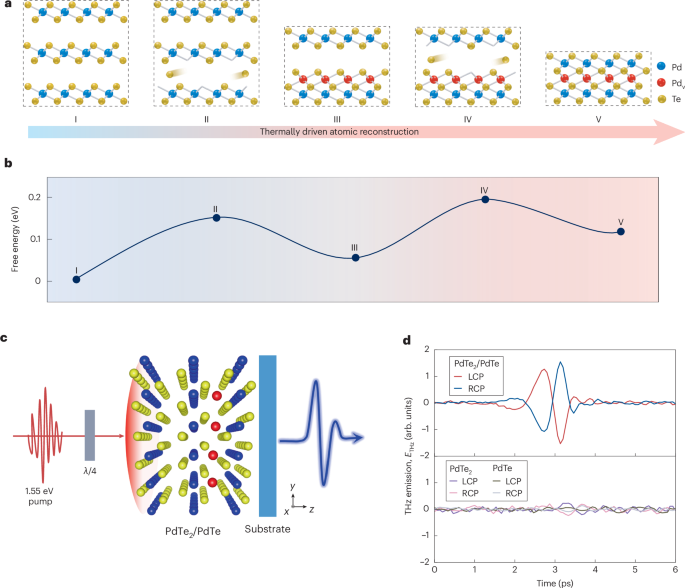
• Subjects Two-dimensional materials Tellurium vacancies can drive atomic reconstruction in PdTe2thin films, converting them into non-layered PdTe. • Such a non-stoichiometric phase transition yields large-scale thin-film superconductors and can also create an intermediate heterostructure that enables helicity-sensitive terahertz emission. • This is a preview of subscription content,access via your institution Access options Access Nature and 54 other Nature Portfolio journals Get Nature+, our best-value online-access subscription 27,99 €/ 30 days cancel any time Subscribe to this journal Receive 12 print issues and online access 251,40 € per year only 20,95 € per issue Rent or buy this article Prices vary by article type from$1.95 to$39.95 Prices may be subject to local taxes which are calculated during checkout References Li, W., Qian, X. • Mater.6, 829-846 (2021).ArticleCASGoogle Scholar Li, W., Qian, X. • Mater.6, 829-846 (2021). • ArticleCASGoogle Scholar Zhao, X.
Article Summaries:
- Researchers have shown that introducing tellurium vacancies into PdTe₂ thin films triggers an atomic reconstruction that transforms the layered material into a denser, non‑layered PdTe phase. This non‑stoichiometric transition produces large‑area thin‑film superconductors and simultaneously creates an intermediate heterostructure capable of helicity‑sensitive terahertz emission. The study demonstrates a controllable route to engineer phase‑change materials for superconducting devices and ultrafast optoelectronics, highlighting the role of vacancy‑driven reconstruction in tailoring electronic and optical properties of transition‑metal dichalcogenides in both fundamental research and potential applications.
Sources: