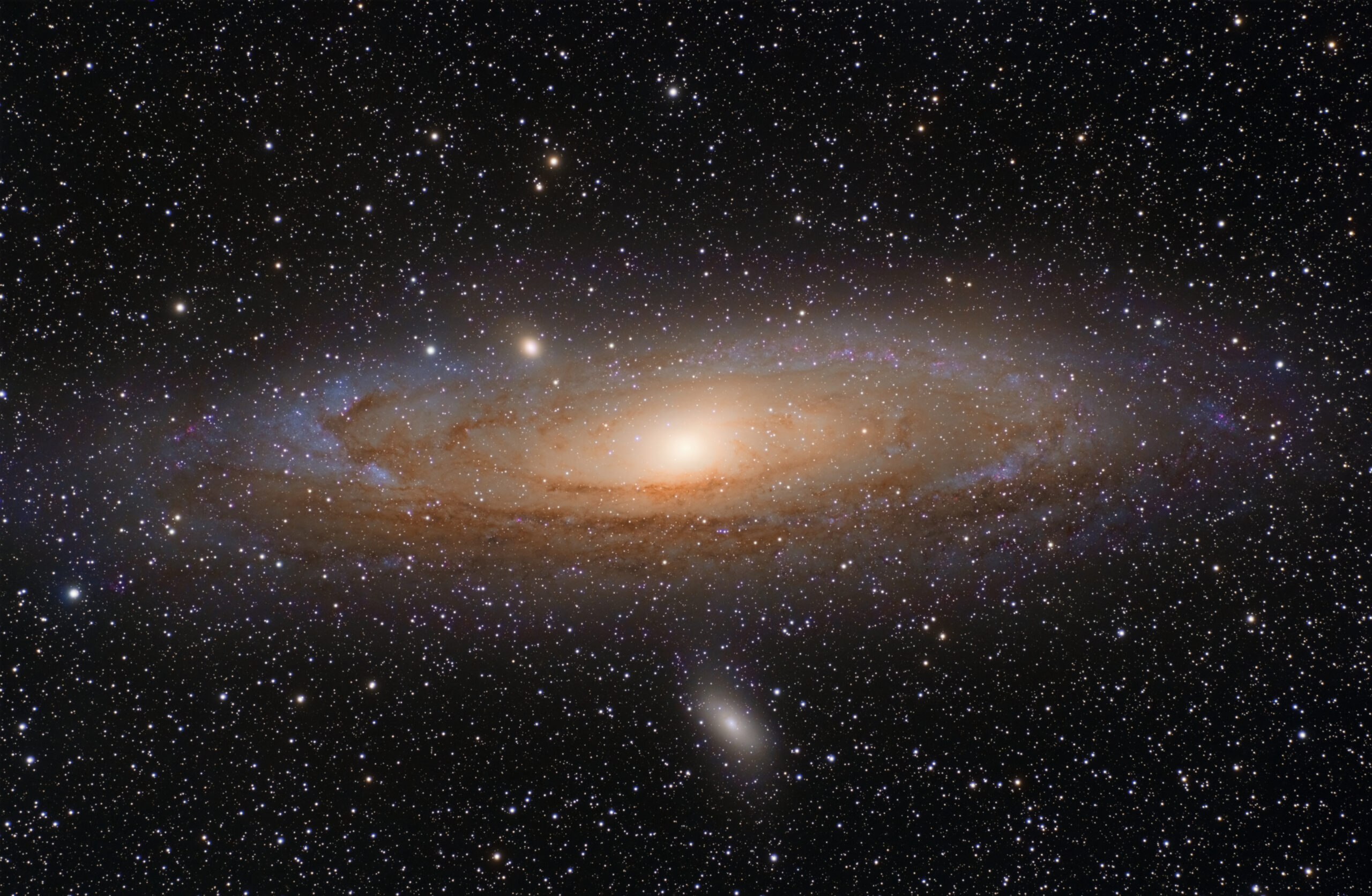
• Primordial Black Holes lensing my Andromeda Galaxy? • It could be more common than you think byAnavi Uppal| Feb 9, 2026 |Daily Paper Summaries|0 comments Title:Microlensing constraint on Primordial Black Hole abundance with Subaru Hyper Suprime-Cam observations of Andromeda Authors:Sunao Sugiyama, Masahiro Takada, Naoki Yasuda, and Nozomu Tominaga First Author’s Institution:Kavli Institute for the Physics and Mathematics of the Universe (WPI) Status:Available on arXiv [openaccess] Primordial Black Holes(PBHs) aren’t like the black holes that we’re used to - while typical black holes form from the death of massive stars, PBHs are a theoretical type of black hole that formed from the collapse of primordial density fluctuations in the very early universe. • These black holes could be as lightweight as an asteroid! • PBHs have never been definitively observed, but they could be a non-negligible fraction ofwhat makes up dark matter. • But if these black holes are so tiny, how can we ever hope to observe them? • The answer ismicrolensing.
Article Summaries:
- Researchers using Subaru’s Hyper Suprime‑Cam monitored the Andromeda Galaxy for 40 hours across ten nights between 2014 and 2020 to search for microlensing signatures of primordial black holes (PBHs). By filtering out variable stars, atmospheric noise, and requiring symmetric, single‑peak light curves with at least 1.34× magnification, they identified 12 candidate PBH microlensing events. The team assessed detection efficiency with simulated light curves, enabling estimates of PBH abundance and mass distribution. These findings suggest PBHs may be more common than previously thought and could contribute significantly to the dark matter content of the universe.
Sources: