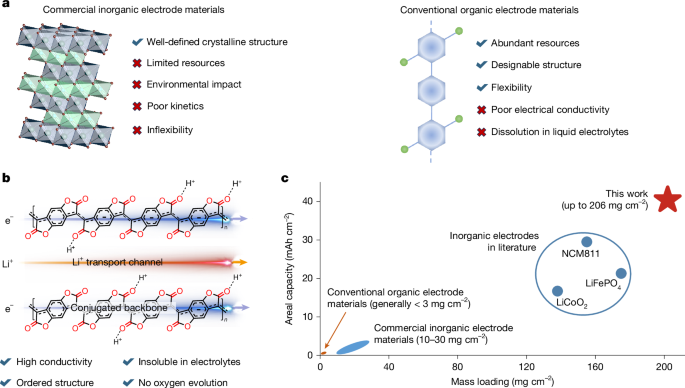
• Abstract Organic batteries using abundant and recyclable organic electrode materials provide a sustainable and environmentally friendly alternative to commercial lithium-ion batteries1,2,3,4,5, which rely on resource-limited mineral-derived inorganic electrode materials6,7,8. • However, the practical use of organic batteries has been severely hindered by the intrinsic insulation and dissolution of organic electrode materials9,10. • Here we report practical organic batteries using an n-type conducting polymer cathode, poly(benzodifurandione) (PBFDO), which exhibits excellent mixed ionic and electronic transport and low solubility. • The PBFDO cathode maintains its n-doped state throughout the electrochemical processes and exhibits stable and reversible redox characteristics, high electrical conductivities and significant lithium-ion diffusion coefficients, without the need for additional conductive additives. • Consequently, ultrahigh-mass-loading polymer cathodes, with mass loadings up to 206 mg cm−2, are realized, delivering a high areal capacity of 42 mAh cm−2 and demonstrating robust cycling stability. • Furthermore, practical 2.5 Ah lithium-organic pouch cells were fabricated, achieving an impressive energy density of 255 Wh kg−1.
Article Summaries:
- Researchers have demonstrated practical lithium‑organic batteries using an n‑type conducting polymer cathode, poly(benzodifurandione) (PBFDO). The polymer shows mixed ionic/electronic transport, low solubility, and remains n‑doped during cycling, eliminating the need for conductive additives. Cathodes with mass loadings up to 206 mg cm⁻² deliver an areal capacity of 42 mAh cm⁻² and maintain stable cycling. A 2.5 Ah pouch cell fabricated from this cathode achieved 255 Wh kg⁻¹ energy density. The system operates efficiently from -70 °C to 80 °C, offering flexibility and safety for extreme‑condition and wearable applications.
Sources: