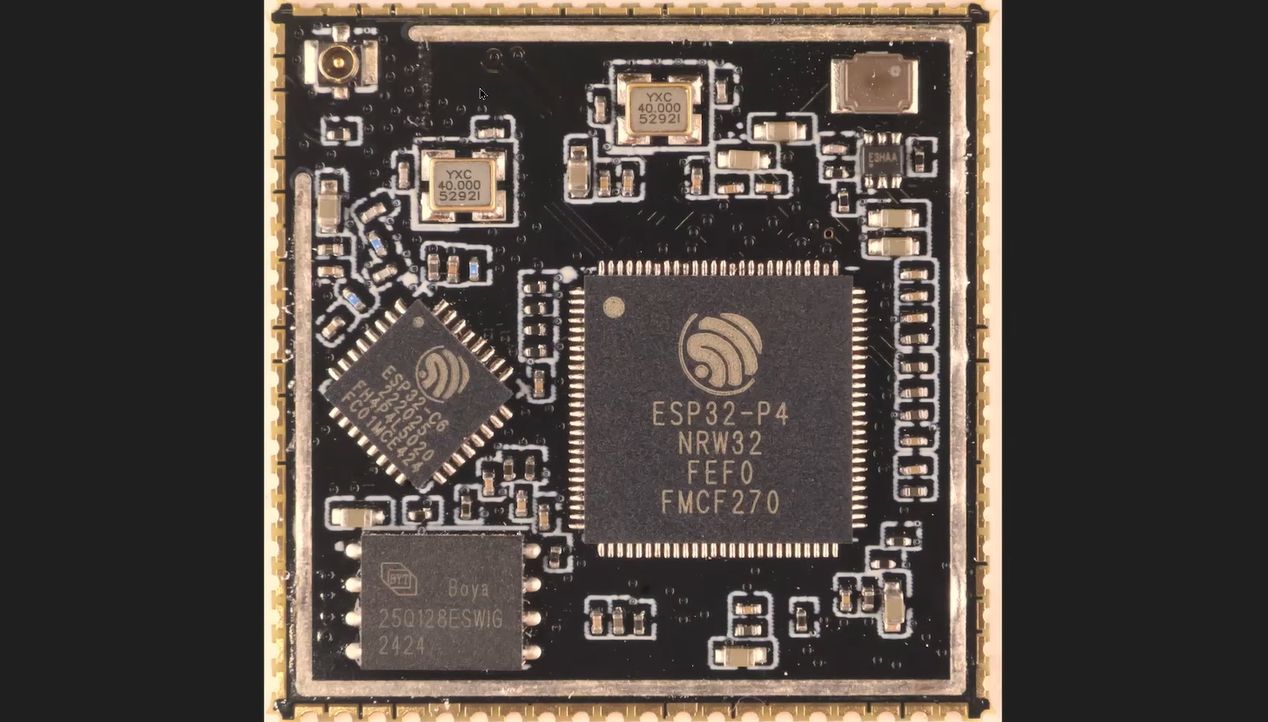
• With the ESP32-P4 not having any wireless functionality and instead focusing on being a small SoC, it makes sense to combine it with a second chip that handles features like WiFi and Bluetooth. • This makes the Guition ESP32-P4-M3 module both a pretty good example of how the P4 will be used, and an excellent opportunity totear into, decap and shoot photos of the diesof both the P4 and the ESP32-C6 in this particular module, courtesy of [electronupdate]. • There also theblog postfor those who just want to ogle the shinies. • After popping the metal shield on the module, you can see the contents as in the above photo. • The P4 inside is a variant with 32 MB of PSRAM integrated along with the SoC die. • This results in a die shot both of this PSRAM and the P4 die, though enough of the top metal seems to remain to clearly see the latter.
Article Summaries:
- The Guition ESP32‑P4‑M3 module demonstrates how Espressif’s new ESP32‑P4 SoC can be paired with a second chip to provide wireless capability. The module houses the P4 core, a 32 MB PSRAM‑integrated variant, and an ESP32‑C6 MCU that supplies Wi‑Fi and Bluetooth. A recent teardown by electronupdate revealed die dimensions of 4.29 × 3.66 mm for the P4 and 2.7 × 2.7 mm for the C6, along with a standard Boya flash chip and crystal oscillator. The photo‑rich post offers clear views of the dies, illustrating the P4’s compact design and the C6’s simpler RF section.
Sources: