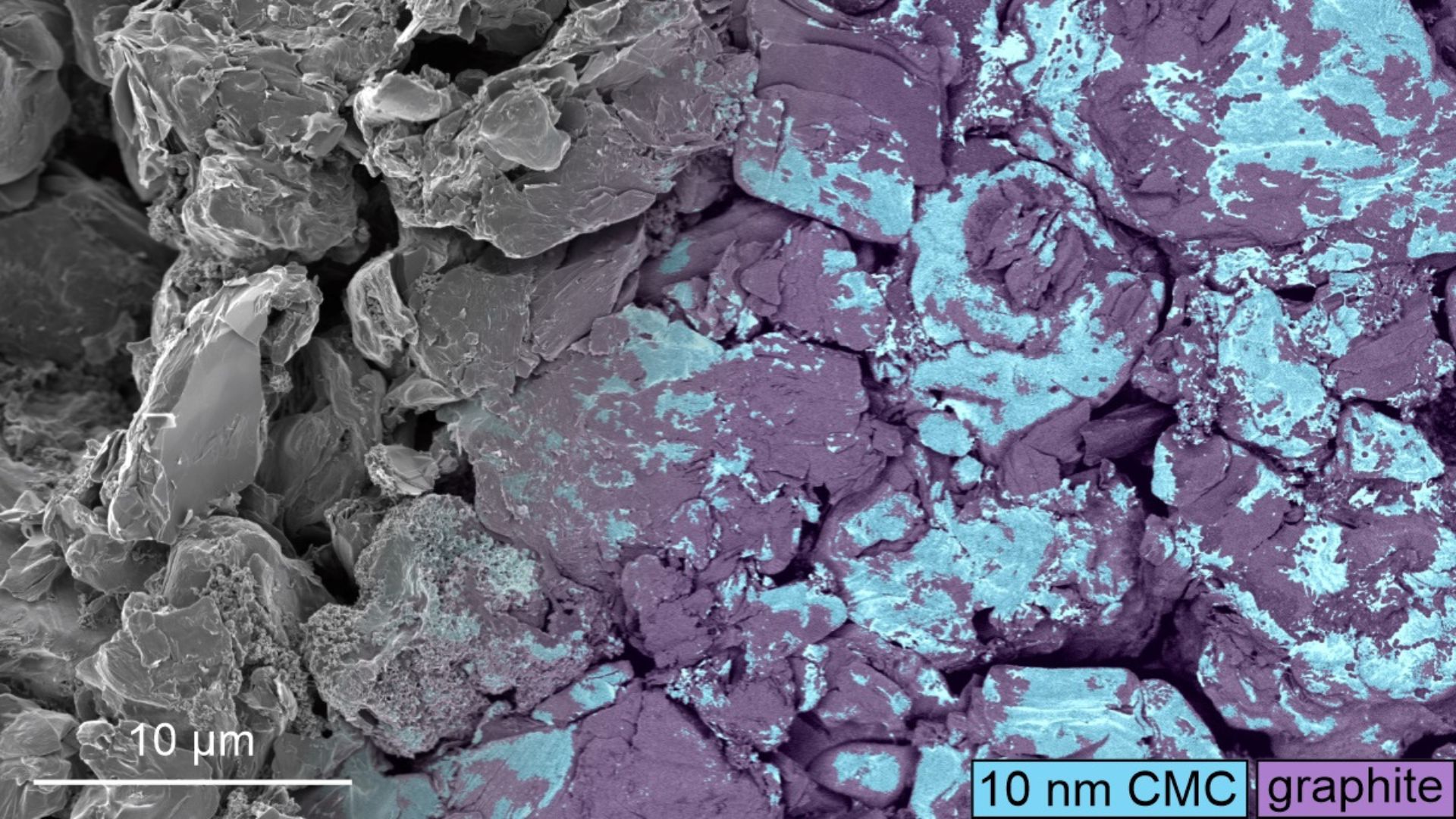
• Oxford method maps hidden binders that could aid EV battery charging and life The team identified issues with 10-nanometer-thick carboxymethyl cellulose (CMC) binder layers. • A new staining technique developed by researchers at the University of Oxford has helped spot modern polymer binders used in the negative electrodes of lithium-ion batteries. • Lacking distinct features and used in the electrode at less than five percent by weight, the component plays an important role in holding the electrodes together, and spotting it can help improve its performance, according to a press release. • Lithium-ion batteries have the highest energy density of any energy storage technology built to date. • Their compact nature and high energy holding capacity make everything from a smartphone to an electric vehicle (EV) possible. • Yet scientists are working to further improve these batteries, including their conductivity, durability, and stability.
Article Summaries:
- Oxford method maps hidden binders that could aid EV battery charging and life The team identified issues with 10-nanometer-thick carboxymethyl cellulose (CMC) binder layers. A new staining technique developed by researchers at the University of Oxford has helped spot modern polymer binders used in the negative electrodes of lithium-ion batteries. Lacking distinct features and used in the electrode at less than five percent by weight, the component plays an important role in holding the electrodes together, and spotting it can help improve its performance, according to a press release. Lithium-
Sources: