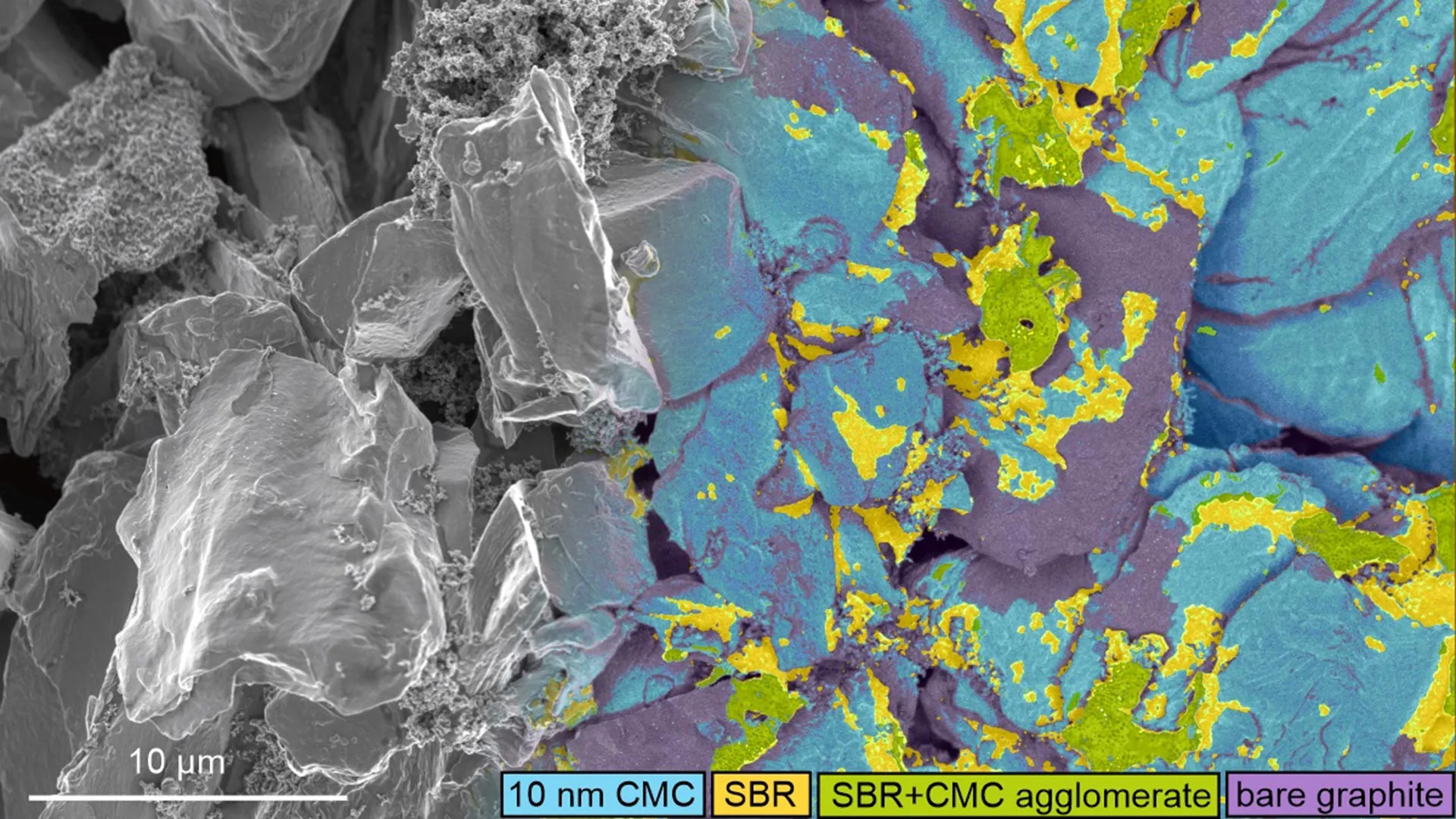
• Oxford breakthrough could make lithium-ion batteries charge faster and last much longer A team at the University of Oxford has created an advanced technique that makes it possible to clearly see a vital component inside lithium-ion battery electrodes that scientists have struggled to track. • The findings, published on February 17 inNature Communications, could make battery manufacturing more efficient and help improve both charging speed and the overall lifespan of Li-ion batteries. • The research zeroed in on polymer binders used in the negative electrodes of lithium-ion batteries (anodes). • These binders act like a glue that holds the electrode materials together. • Even though they account for less than 5% of the electrode’s total weight, they strongly influence mechanical strength, electrical and ionic conductivity, and how long a battery can operate through repeated charge cycles. • Because binders are present in such small amounts and lack clear visual signatures, scientists have had difficulty determining exactly where they are located within the electrode.
Article Summaries:
- Oxford researchers have developed a patent‑pending staining technique that tags polymer binders in lithium‑ion battery anodes with traceable silver and bromine markers. The markers enable high‑resolution mapping of binder distribution at the nanoscale using electron microscopy and X‑ray spectroscopy. By visualizing how binders are arranged, the team identified that small manufacturing adjustments can cut internal resistance by up to 40%. This improvement could allow faster charging and extend battery life for both current graphite‑based cells and next‑generation silicon‑based designs. The findings were published in Nature Communications on February 17, 2026.
Sources: