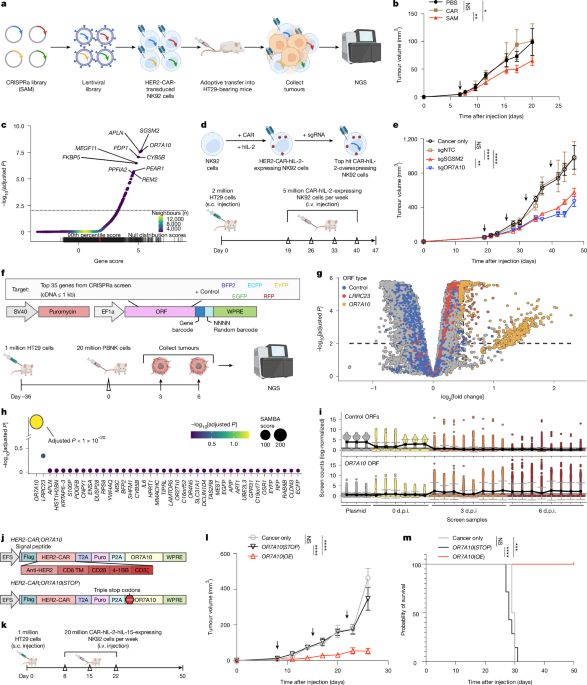
• Abstract Chimeric antigen receptor (CAR)-natural killer (NK) cell therapies hold promise for solid tumours but remain limited because of poor tumour infiltration, persistence and resistance in the tumour microenvironment1,2,3,4 • Here, to identify gain-of-function targets that enhance CAR-NK cell efficacy, we performed an unbiased in vivo CRISPR activation screen followed by a barcoded targeted in vivo open reading frame screen in primary human CAR-NK cells • We identified and comprehensively validated OR7A10, a G protein-coupled receptor (GPCR), as the top candidate • Engineering CAR-NK cells with OR7A10 cDNA (a CRISPR-independent method with a simple manufacturing strategy) enhanced their proliferation, activation, degranulation, cytokine production, death ligand expression, chemokine receptor expression, cytotoxicity, persistence, metabolic fitness and tumour microenvironment resistance • Moreover, exhaustion in primary human NK cells derived from multiple peripheral blood and cord blood donors was reduced • OR7A10 gain-of-function CAR-NK cells displayed strong in vivo efficacy across multiple solid tumour models
Article Summaries:
- Abstract Chimeric antigen receptor (CAR)-natural killer (NK) cell therapies hold promise for solid tumours but remain limited because of poor tumour infiltration, persistence and resistance in the tumour microenvironment1,2,3,4. Here, to identify gain-of-function targets that enhance CAR-NK cell efficacy, we performed an unbiased in vivo CRISPR activation screen followed by a barcoded targeted in vivo open reading frame screen in primary human CAR-NK cells. We identified and comprehensively validated OR7A10, a G protein-coupled receptor (GPCR), as the top candidate. Engineering CAR-NK cells wi
Sources:
- https://www.nature.com/articles/s41586-026-10149-8 (Latest source article published: 2026-02-25 17:32 UTC)