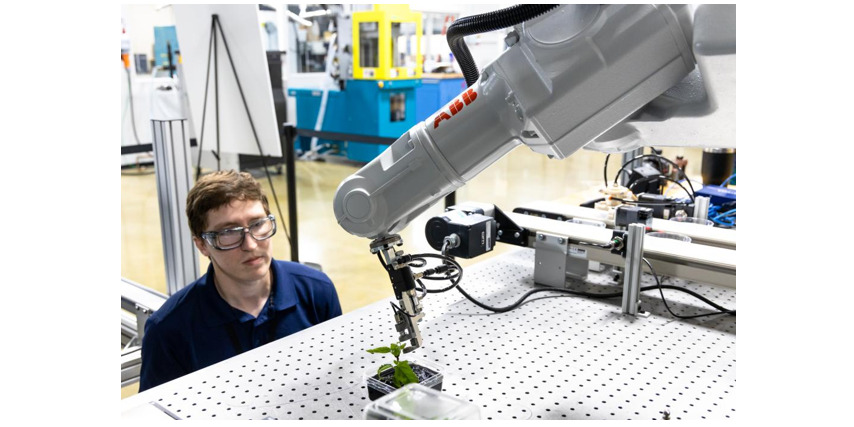
• Oak Ridge National Laboratory reports that plant scientists have teamed with manufacturing systems engineers at the lab to develop robotics and computer vision on development of new stress-tolerant plants. • The research is intended to benefit applications ranging from better bioenergy and food crops to new materials, chemicals, and for recovery of critical minerals. • The project, called SMART Plant 1.0 (Sensors, Machine vision, Automation and Robotics for Transforming Plants), successfully demonstrated an early stage plant transformation system that uses robotics to replace a laborious, manual task in plant science. • SMART Plant 1.0 identified and robotically collected tissue from live plants, treated it to transform and trigger growth, and placed it on a special nutrient blend so that it develops a cell mass that can form a new plant. • SMART Plant 1.0 aims to make the process faster, more consistent and reliable by automating this task at the heart of predictive plant biology. • The system, detailed in an IEEE conference paper, could increase plant transformation efficiency by a hundredfold.
Article Summaries:
- Oak Ridge National Laboratory reports that plant scientists have teamed with manufacturing systems engineers at the lab to develop robotics and computer vision on development of new stress-tolerant plants. The research is intended to benefit applications ranging from better bioenergy and food crops to new materials, chemicals, and for recovery of critical minerals. The project, called SMART Plant 1.0 (Sensors, Machine vision, Automation and Robotics for Transforming Plants), successfully demonstrated an early stage plant transformation system that uses robotics to replace a laborious, manual t
Sources:
- https://insidehpc.com/2026/02/oak-ridge-engineers-and-plant-biologists-automate-plant-transformation-for-scientific-discovery/ (Latest source article published: 2026-02-19 20:59 UTC)