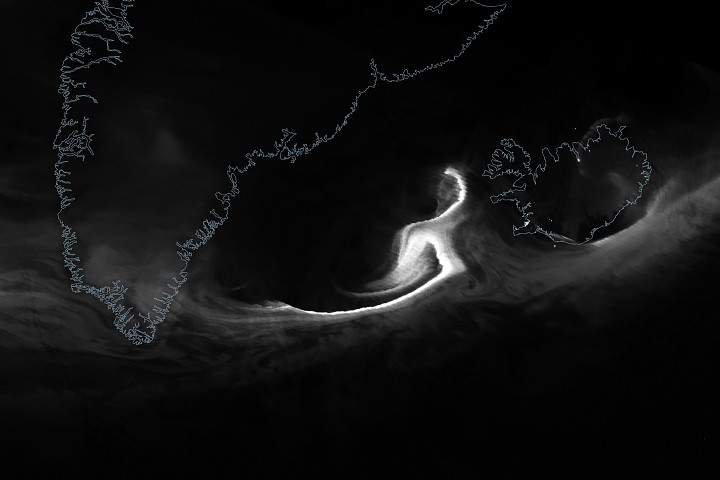
• Aurora borealis illuminated Iceland and eastern Canada during a February 2026 geomagnetic storm. • Suomi NPP’s VIIRS captured grayscale images revealing colorful ribbons of light. • Minor G1 storm enabled high‑latitude aurora visibility, with slight power grid fluctuations. • Storm intensified to G2 later, driven by coronal hole and high‑speed solar wind. • Observers saw green, purple, and red auroras across Denmark Strait and Canadian provinces. • Satellite data help scientists monitor space weather impacts on satellites and grids.
Article Summaries:
- A minor geomagnetic storm (G1) on 16 Feb 2026 produced a vivid aurora borealis that stretched from Iceland’s Denmark Strait to Canada’s Québec and Newfoundland & Labrador. Images from the Suomi NPP satellite’s VIIRS day‑night band captured the display at 04:45 UT and 06:30 UT, respectively. NOAA’s Space Weather Prediction Center noted the storm’s progression to a moderate G2 later that day, potentially extending auroral visibility as far south as New York and Idaho. A week earlier, NASA’s GNEISS sounding‑rocket mission launched from Poker Flat, Alaska, to study auroral electric currents, providing data for 3‑D reconstructions of the northern lights’ ionospheric drivers.
- A minor geomagnetic storm on February 16, 2026 produced a vivid aurora borealis that stretched from Iceland’s Denmark Strait to Canada’s Québec and Newfoundland and Labrador. The VIIRS day‑night band on the Suomi NPP satellite captured the display in early‑morning hours, showing green‑to‑red ribbons over the northern skies. NOAA classified the event as a G1 storm, the lowest level, but later that day it intensified to a G2, potentially extending auroral visibility as far south as New York and Idaho. Earlier that week, NASA’s GNEISS sounding rockets launched from Alaska to study the electrical currents driving the aurora, providing data for 3‑D reconstructions of space‑weather processes.
Sources: