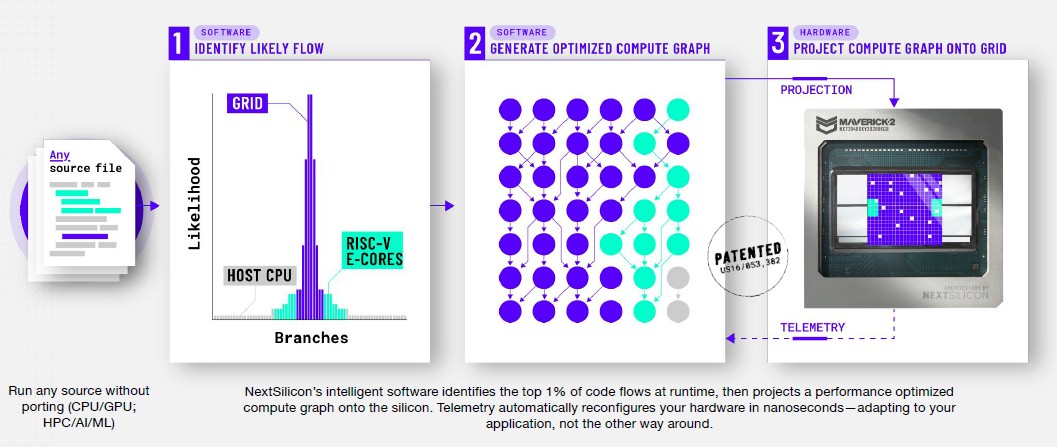
• A few months back, Sandia National Laboratoriesannounced they had acquired a new supercomputer. • It wasn’t the biggest, but it still offered in their eyes something unique. • This particular supercomputer contains NextSilicon’s much-hyped Maverick-2 ‘dataflow accelerator’ chips. • Targeting the high-performance computing (HPC) market, these chips are claimed to hold a 10x advantage over the best GPU designs. • The strategy here appears to be somewhat of a mixture betweenVLIW, FPGAs and Sony’s Cell architecture, with a dedicated compiler that determines the best mapping of a particular calculation across the compute elements inside the chip. • Naturally, the exact details about the internals are a closely held secret by NextSilicon and its partners (like Sandia), so we basically have only the public claims and PR material to go by.
Article Summaries:
- Sandia National Laboratories has added a new supercomputer to its fleet that centers on NextSilicon’s Maverick‑2 data‑flow accelerator chips. The chips, which combine elements of VLIW, FPGA, and Sony’s Cell architectures, are said to deliver up to ten times the performance of current top GPUs for parallel workloads, though single‑threaded speed remains limited. A custom compiler maps calculations to the accelerator’s heterogeneous compute elements. While the die size is large and manufacturing costly, the system is intended for high‑performance computing tasks such as advanced fluid‑dynamics simulations used in national‑security nuclear‑deterrent modeling. Details of the internal design remain proprietary.
Sources: