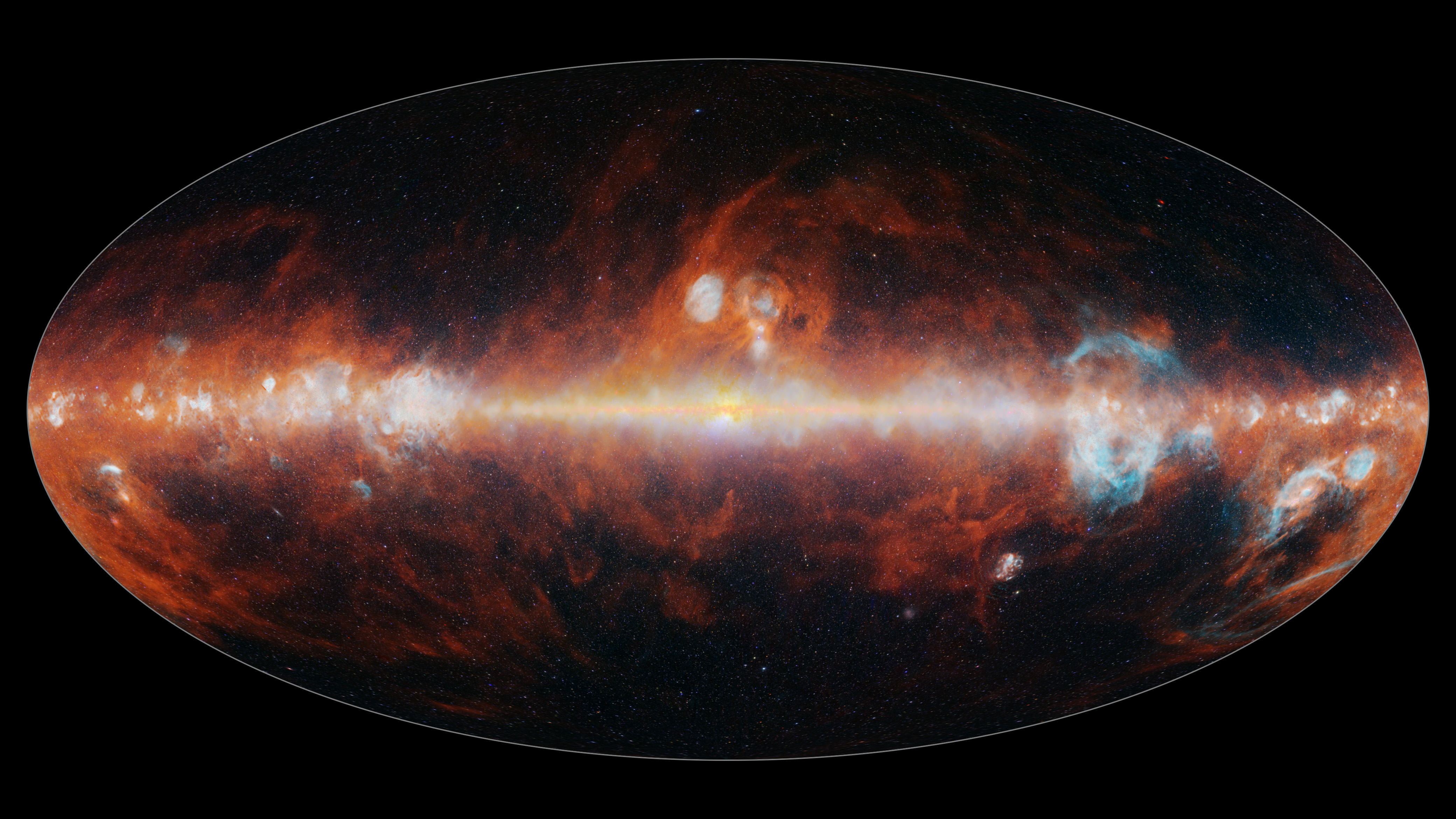
• NASA’s SPHEREx Observatory Completes First Cosmic Map Like No Other This panoramic view of SPHEREx’s first all-sky map shows how the sky looks to the telescope. • It transitions between observations of colors emitted by hot hydrogen gas (blue) and cosmic dust (red), and those primarily emitted by stars. • The telescope will help scientists answer big-picture questions about everything from water deposits in the Milky Way to what happened in the first second after the big bang. • Launched in March, NASA’s SPHEREx space telescope has completed its first infrared map of the entire sky in 102 colors. • While not visible to the human eye, these 102 infrared wavelengths of light are prevalent in the cosmos, and observing the entire sky this way enables scientists to answer big questions, including how a dramatic event that occurred in the first billionth of a trillionth of a trillionth of a second after the big bang influenced the 3D distribution of hundreds of millions of galaxies in our universe. • In addition, scientists will use the data to study how galaxies have changed over the universe’s nearly 14 billion-year history and learn about the distribution of key ingredients for life in our own galaxy.
Article Summaries:
- NASA’s SPHEREx space telescope has finished its first all‑sky infrared survey, mapping the entire sky in 102 distinct wavelengths. Launched in March and beginning observations in May, the mission completed the mosaic in December after six months of continuous imaging. The data, freely available to scientists and the public, will help probe the early universe, track galaxy evolution over 14 billion years, and map key life‑supporting ingredients in the Milky Way. SPHEREx will conduct three additional scans during its two‑year primary mission, increasing sensitivity and providing a unique, multi‑color view of the cosmos.
Sources: