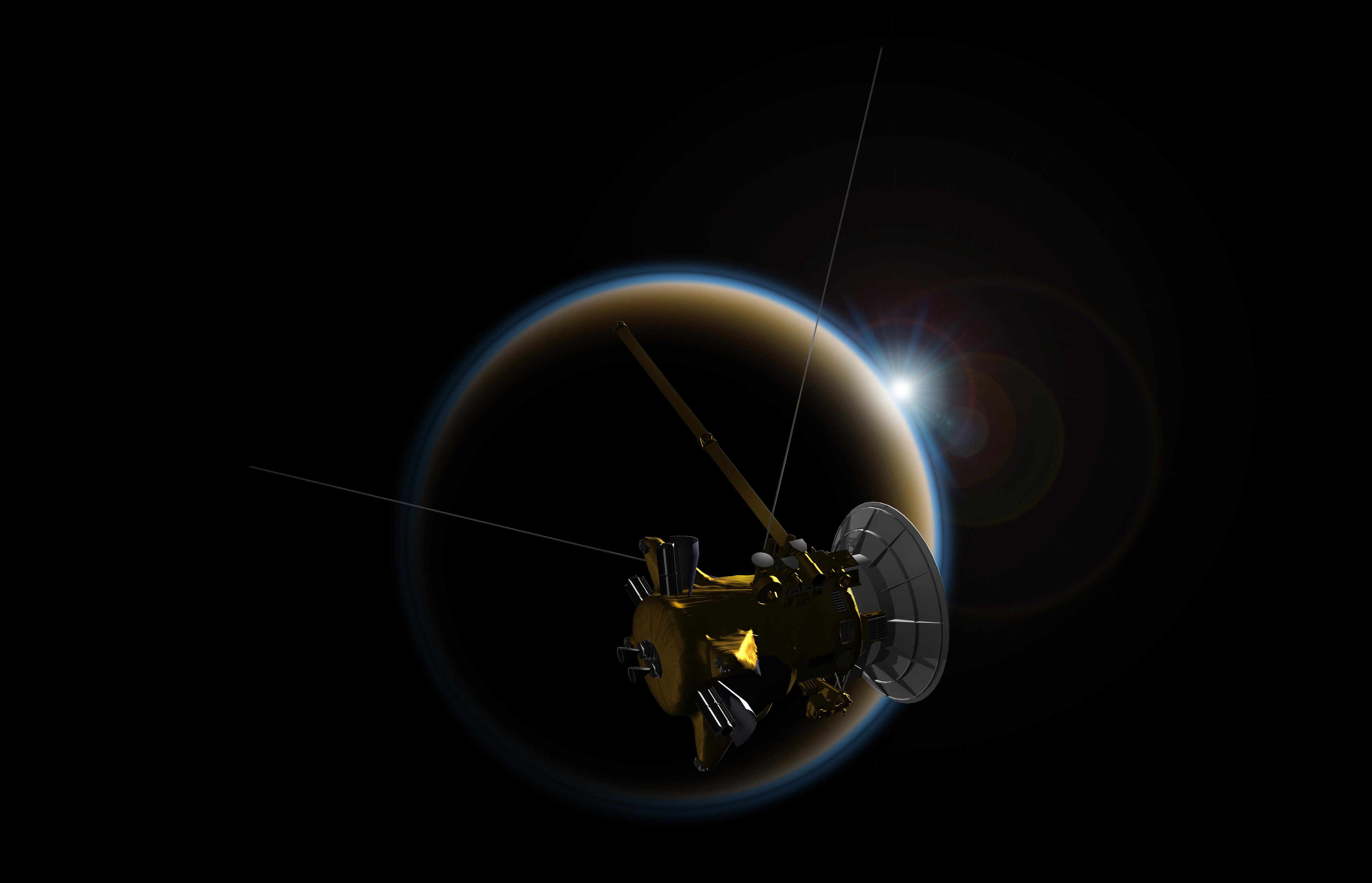
• NASA Study Suggests Saturn’s Moon Titan May Not Have Global Ocean This artist’s concept depicts NASA’s Cassini spacecraft performing one of its many close flybys of Titan, Saturn’s largest moon. • By analyzing the Doppler shift of radio signals traveling to and from Earth, the mission precisely measured Titan’s gravity field. • Credit: NASA/JPL-CaltechFull Image Details Reanalysis of data from NASA’s Cassini mission has revealed Saturn’s moon may instead have layers of slush with isolated pockets of liquid water. • A key discovery from NASA’s Cassini mission in 2008 was that Saturn’s largest moon Titan may have a vast water ocean below its hydrocarbon-rich surface. • But reanalysis of mission data suggests a more complicated picture: Titan’s interior is more likely composed of ice, with layers of slush and small pockets of warm water that form near its rocky core. • Led by researchers at NASA’s Jet Propulsion Laboratory in Southern California andpublishedin the journal Nature on Wednesday, the new study could have implications for scientists’ understanding of Titan and other icy moons throughout our solar system.
Article Summaries:
- A new study published in Nature reexamines Cassini mission data and concludes that Titan likely lacks a global ocean. Researchers at NASA’s Jet Propulsion Laboratory applied advanced noise‑reduction to Doppler shift measurements, revealing energy dissipation consistent with an ice‑rich interior that includes slush layers and small pockets of warm water near the rocky core. The findings suggest Titan’s tidal flexing can be explained without a liquid layer, reshaping models of its internal structure and influencing interpretations of other icy moons. The work highlights the value of archival data and improved analysis techniques for planetary science.
Sources: