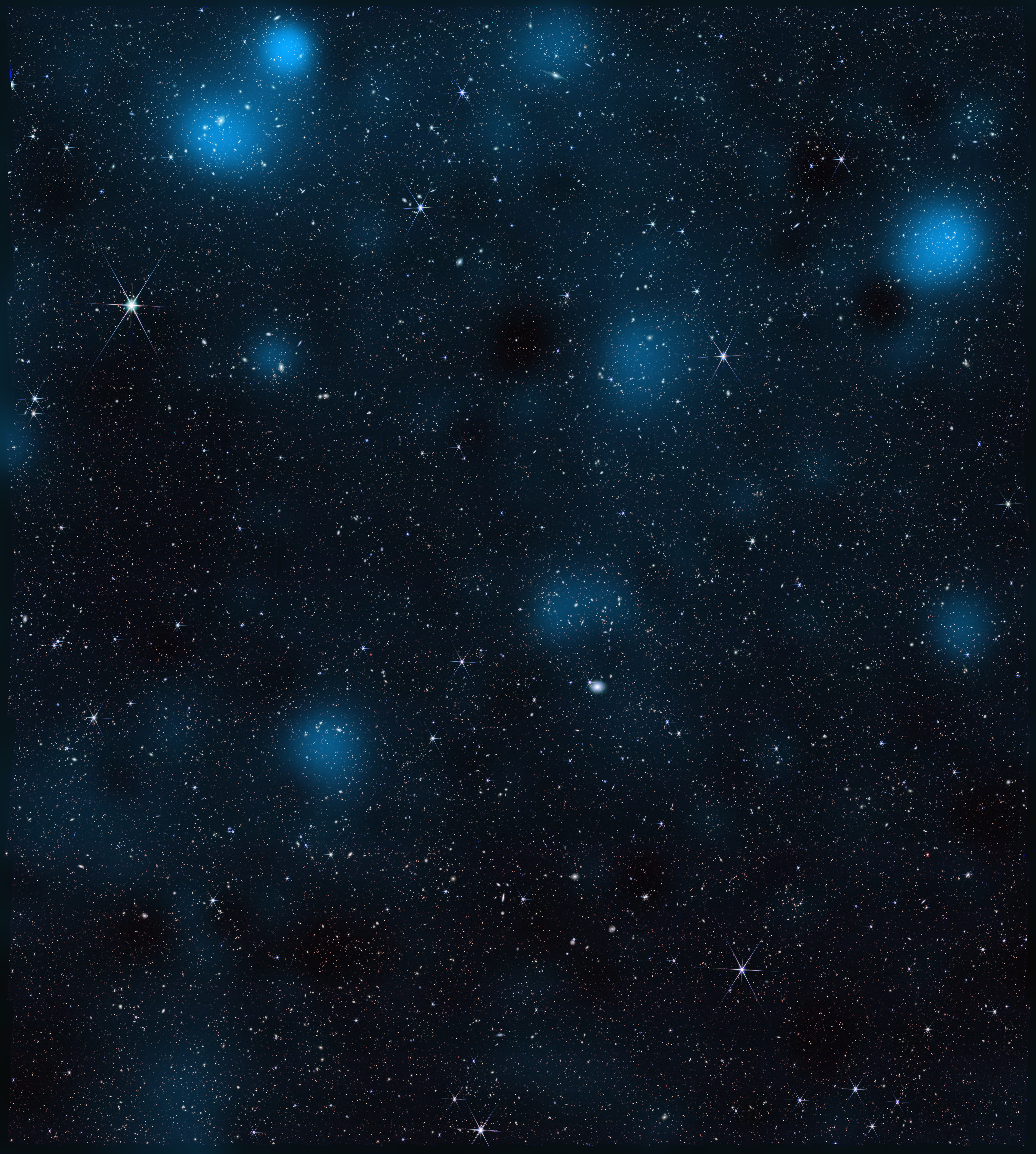
• JWST produced the most detailed, high‑resolution dark matter map ever, twice sharper than previous maps. • Map shows dark matter overlapping and intertwining with visible matter across galaxy clusters millions of light‑years wide. • Researchers confirm dark matter’s role in shaping large‑scale structure, influencing galaxy, star, and planet formation. • The map uses Webb’s unprecedented sensitivity to detect gravitational effects on ordinary matter. • Comparison with Hubble data highlights Webb’s superior resolution, revealing invisible scaffolding of the universe. • Findings published in Nature Astronomy, led by JPL astrophysicist Diana Scognamiglio.
Article Summaries:
- NASA’s James Webb Space Telescope has produced the most detailed high‑resolution map of dark matter to date, covering a sky patch 2½ times the Moon’s size in the constellation Sextans. Using 255 hours of observations, the team identified nearly 800,000 galaxies-about ten times more than previous ground‑based surveys and twice as many as the 2007 Hubble map. The new map shows dark matter and ordinary matter co‑located across galaxy clusters and filaments, confirming that gravity from dark matter has drawn regular matter into the same structures over cosmic history. The study, published in Nature Astronomy, highlights Webb’s superior resolution and the tight alignment between the two matter components.
Sources: