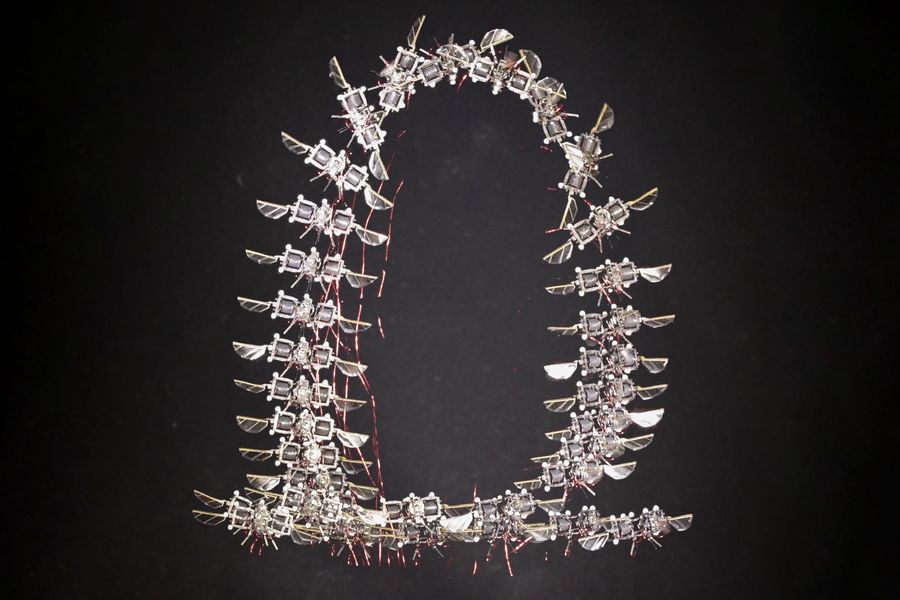
• News Views Podcast Learn team about contribute republish AIhub resources AIhub events News Views Podcast Learn News Views Podcast Learn MIT engineers design an aerial microrobot that can fly as fast as a bumblebee A time-lapse photo shows a flying microrobot performing a flip. • Credit: Courtesy of the Soft and Micro Robotics Laboratory. • By Adam Zewe In the future, tiny flying robots could be deployed to aid in the search for survivors trapped beneath the rubble after a devastating earthquake. • Like real insects, these robots could flit through tight spaces larger robots can’t reach, while simultaneously dodging stationary obstacles and pieces of falling rubble. • So far, aerial microrobots have only been able to fly slowly along smooth trajectories, far from the swift, agile flight of real insects - until now. • MIT researchers have demonstrated aerial microrobots that can fly with speed and agility that is comparable to their biological counterparts.
Article Summaries:
- MIT researchers have developed a micro‑robot that can fly with speed and agility comparable to insects. Using a new AI‑based, two‑part control scheme, the device-smaller than a paperclip and powered by artificial “muscles” that flap its wings-achieved a 450 % increase in speed and 250 % in acceleration over previous models. The robot performed ten consecutive somersaults in 11 seconds, even when wind disturbances threatened its trajectory. The breakthrough, published in Science Advances, demonstrates a computationally efficient controller that could enable tiny drones to navigate tight spaces inaccessible to larger robots, such as disaster‑search scenarios.
Sources: