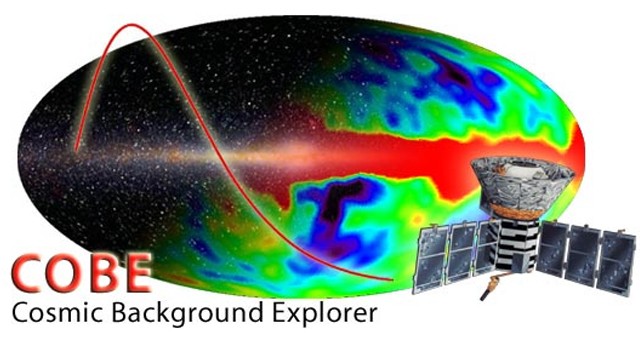
• 4 min read Measuring the Big Bang with the COBE satellite Alicia Cermak The Cosmic Background Explorer satellite (COBE) went up on a Delta rocket on Nov. • 18, 1989, into a polar sun-synchronous orbit 900 km up. • Our team at NASA Goddard Space Flight Center (GSFC), Ball Aerospace, the Jet Propulsion Laboratory (JPL) and universities built it to look at the cosmic microwave and infrared background light that comes to us from the distant universe, so far away that it seems to be a nearly uniform glow. • With it, we started the new subject of precision cosmology; before the COBE very little was known except the general idea of an expanding universe, misnamed the Big Bang. • (It’s misnamed because the name conjures up the image of a firecracker, happening at a place and a time. • Astronomers see an infinite universe expanding into itself, with no center, no edge and no first moment.) Our team measured the spectrum of the cosmic heat ― more precisely the cosmic microwave background radiation― left over from times when the universe was compressed and hot, with a precision of 50 parts per million.
Sources: