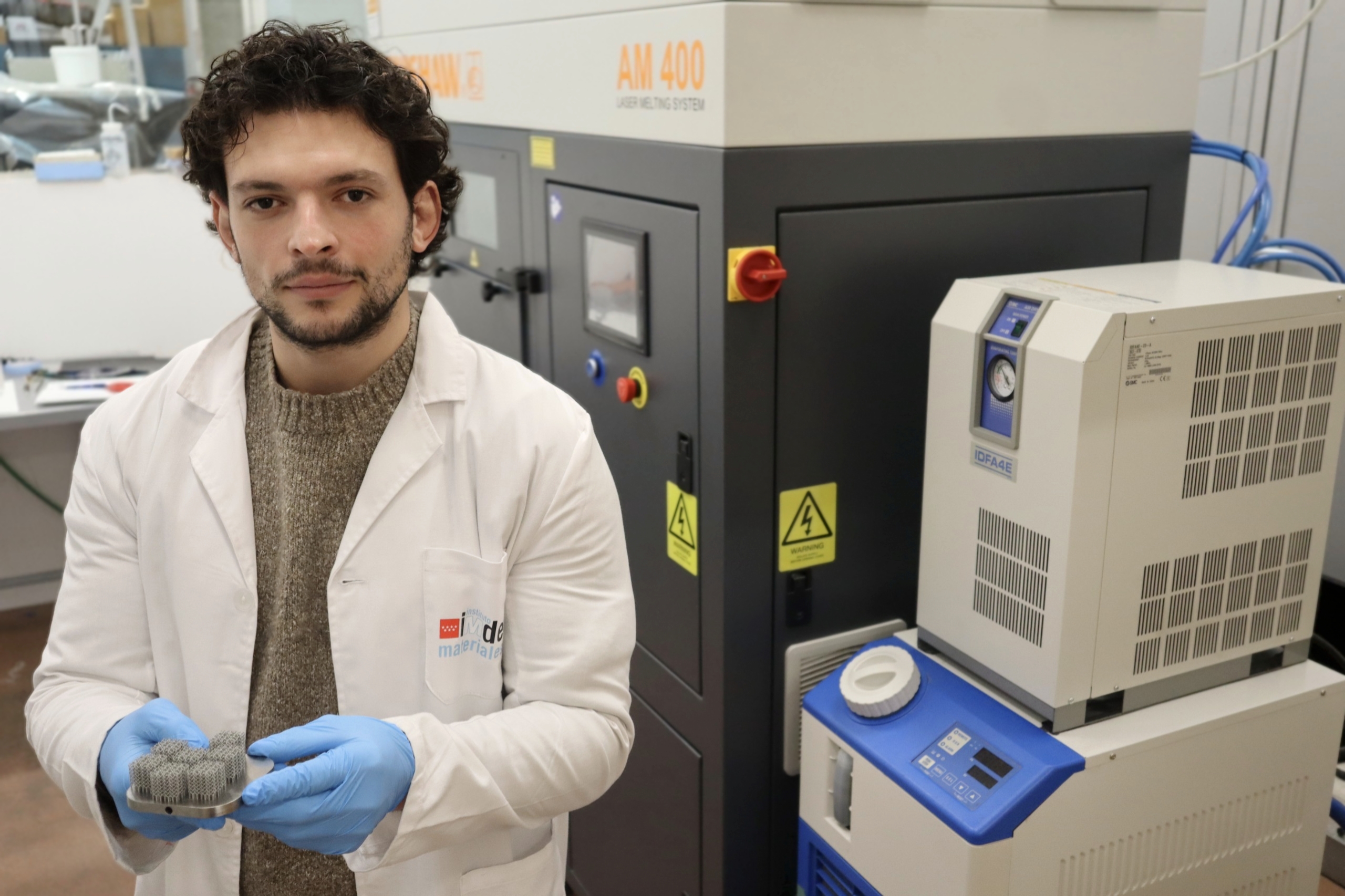
• LPBF Woven Nitinol Opens New Possibilities for Stents and Actuators Share this Article Nitinolis a very exciting material in and of itself. • The alloy is almost a metal elastomer and is known for its strength, super elasticity, andshape memory properties. • Originally discovered in Roswell, New Mexico, it may have originated from the Naval Ordinance Laboratory and Batelle, while some adhere to a much more colorful theory that it is a material found on alien spacecraft. • Primarily used in stents, high-end actuation, orthodontic wires, and some eyeglasses,nitinolis an exotic alloy withdistinctive properties. • Woven, braided, and tubed nitinol wire is already used in cathetertubing and heart valves. • Inadditive, Nitinolparts have been made using LPBF, Ebeam, and several DED processes.
Article Summaries:
- Researchers at IMDEA Materials and the Technical University of Madrid have demonstrated that laser‑powder‑bed fusion (LPBF) can produce woven nitinol lattices with tunable superelastic and shape‑memory properties. By designing specific cylinder‑ and tube‑shaped metamaterials, the team achieved dramatic variations in stiffness, load‑bearing capacity, energy absorption, and toughness-effects that were previously unattainable with conventional additive manufacturing of NiTi. The study shows that architectural optimization can mitigate the mechanical drawbacks of LPBF, enabling self‑supported, high‑performance nitinol wovens. This breakthrough opens new avenues for medical devices such as stents and high‑precision actuators.
Sources: