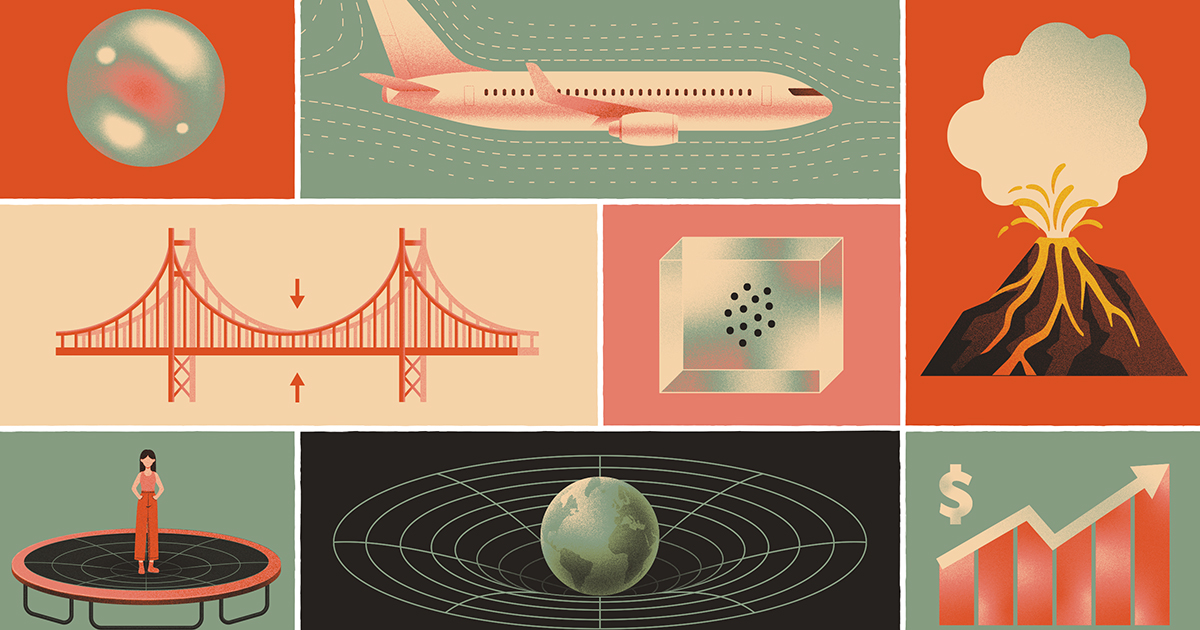
• CommentComments Save ArticleRead LaterRead Later Long-Sought Proof Tames Some of Math’s Unruliest Equations February 6, 2026 To study the flow of air around an airplane’s wing, the distribution of stress on a bridge, or various other situations, researchers use elliptic partial differential equations. • These equations are notoriously difficult to understand. • Kristina Armitage; Michael Kanyongolo/Quanta Magazine Introduction The trajectory of a storm, the evolution of stock prices, the spread of disease - mathematicians can describe any phenomenon that changes in time or space using what are known as partial differential equations. • But there’s a problem: These “PDEs” are often so complicated that it’s impossible to solve them directly. • Mathematicians instead rely on a clever workaround. • They might not know how to compute the exact solution to a given equation, but they can try to show that this solution must be “regular,” or well-behaved in a certain sense - that its values won’t suddenly jump in a physically impossible way, for instance.
Article Summaries:
- Long-Sought Proof Tames Some of Math’s Unruliest Equations Introduction The trajectory of a storm, the evolution of stock prices, the spread of disease - mathematicians can describe any phenomenon that changes in time or space using what are known as partial differential equations. But there’s a problem: These “PDEs” are often so complicated that it’s impossible to solve them directly. Mathematicians instead rely on a clever workaround. They might not know how to compute the exact solution to a given equation, but they can try to show that this solution must be “regular,” or well-behaved in a
Sources: