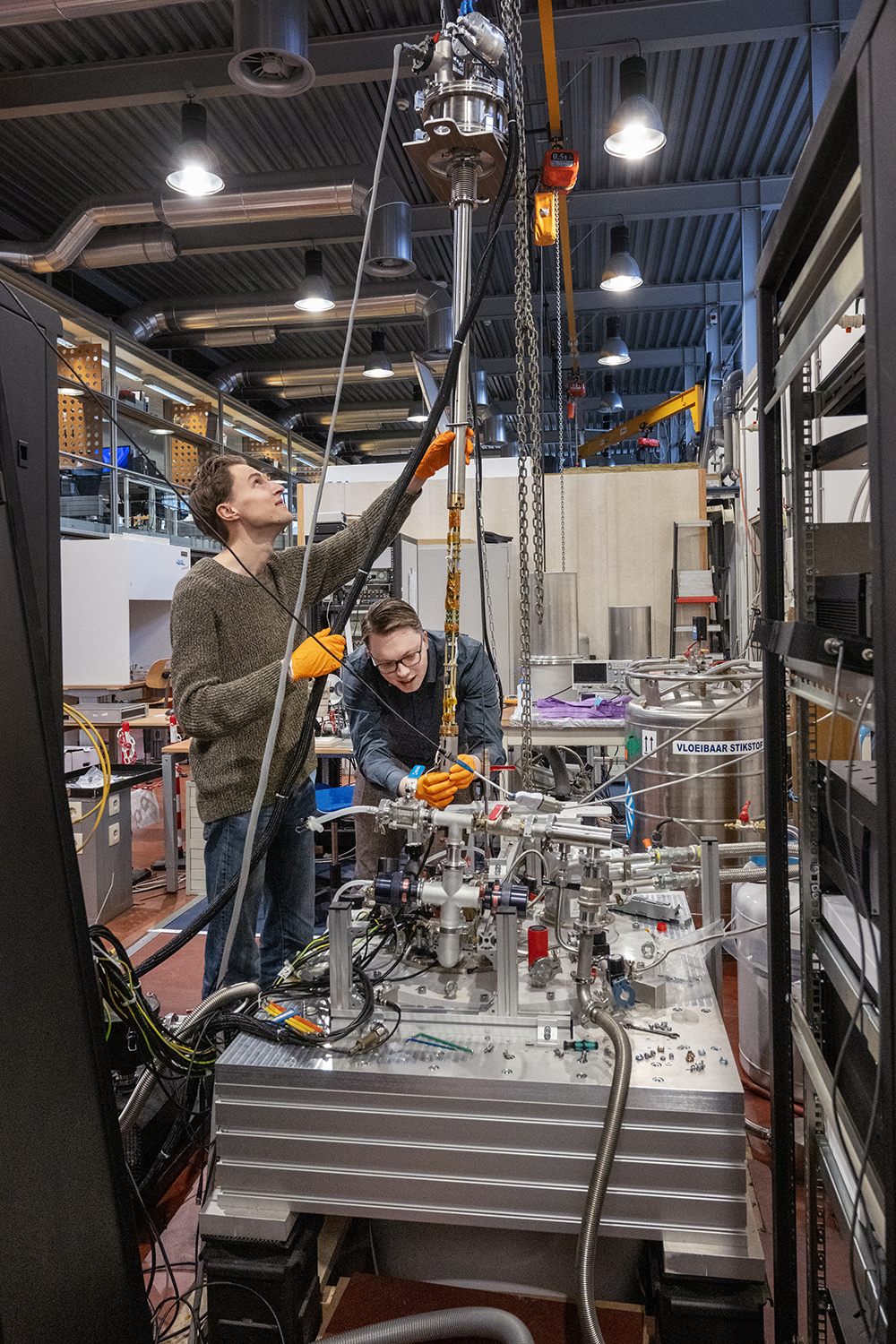
• Physicists atLeiden University, in collaboration with the startupQuantaMap, have unveiled a breakthrough microscope specifically engineered for the “quantum age.” Published inNano Letterson February 12, 2026, the Tapping-Mode SQUID-on-Tip (TM-SOT) microscope, affectionately nicknamed “Tortilla,” is the first industrial-grade tool capable of simultaneously imaging four critical material properties-temperature, magnetism, structure, and electrical behavior-with nanoscale precision in a single scan. • The technical core of the instrument is a nanoSQUID (Superconducting Quantum Interference Device) sensor integrated into the very tip of an atomic force microscope (AFM) probe. • By utilizing tapping-mode feedback, the microscope maintains extreme stability even when scanning highly corrugated or “bumpy” surfaces, such as fully fabricated quantum chips. • This non-invasive technique allows researchers to resolve nanoscale currents as small as 100 nA without the need for lasers or external radiation, which could otherwise disturb delicate quantum states. • The commercialization of this technology is being led by QuantaMap, a Leiden-based startup co-founded byKaveh Lahabi. • The company aims to solve a primary bottleneck in quantum manufacturing: the lack of localized diagnostic tools.
Article Summaries:
- Physicists at Leiden University, in collaboration with the startup QuantaMap, have unveiled a breakthrough microscope specifically engineered for the “quantum age.” Published in Nano Letters on February 12, 2026, the Tapping-Mode SQUID-on-Tip (TM-SOT) microscope, affectionately nicknamed “Tortilla,” is the first industrial-grade tool capable of simultaneously imaging four critical material properties-temperature, magnetism, structure, and electrical behavior-with nanoscale precision in a single scan. The technical core of the instrument is a nanoSQUID (Superconducting Quantum Interference Devi
Sources: