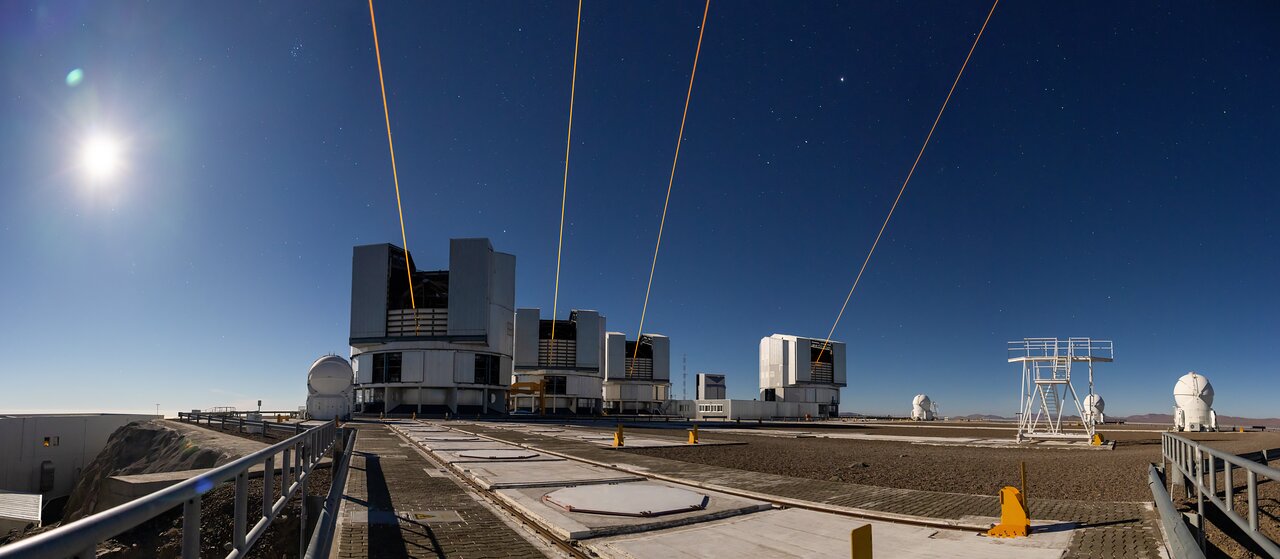
• Press Release Laser trial run kickstarts new era of interferometry 10 November 2025 Last week, four lasers were projected into the skies above the European Southern Observatory’s (ESO’s) Paranal site in Chile. • The lasers are each used to create an artificial star, which astronomers use to measure and then correct the blur caused by Earth’s atmosphere. • The striking launch of these lasers, one from each of the eight-metre telescopes at Paranal, is a significant milestone of the GRAVITY+ project - a large and complex upgrade to ESO’s Very Large Telescope Interferometer (VLTI). • GRAVITY+ unlocks a greater observing power and a much wider sky coverage for the VLTI than previously possible. • “This is a very important milestone for a facility that is completely unique in the world,” says Antoine Mérand, an ESO astronomer and VLTI Programme Scientist. • The VLTI combines light from several individual telescopes of the VLT (either the four eight-metre Unit Telescopes (UTs) or the four smaller Auxiliary Telescopes) using interferometry.
Article Summaries:
- On 10 November 2025, the European Southern Observatory (ESO) launched four lasers from the eight‑metre Unit Telescopes at Paranal, Chile, as part of the GRAVITY+ upgrade to the Very Large Telescope Interferometer (VLTI). The lasers generate artificial stars 90 km above Earth, allowing adaptive‑optics systems to correct atmospheric distortion anywhere in the southern sky. This milestone expands the VLTI’s sky coverage and boosts its sensitivity by up to a factor of ten, enabling deeper observations of faint targets such as distant quasars, young stars, and planet‑forming discs. The upgrade positions the VLTI as the world’s most powerful optical interferometer.
Sources: