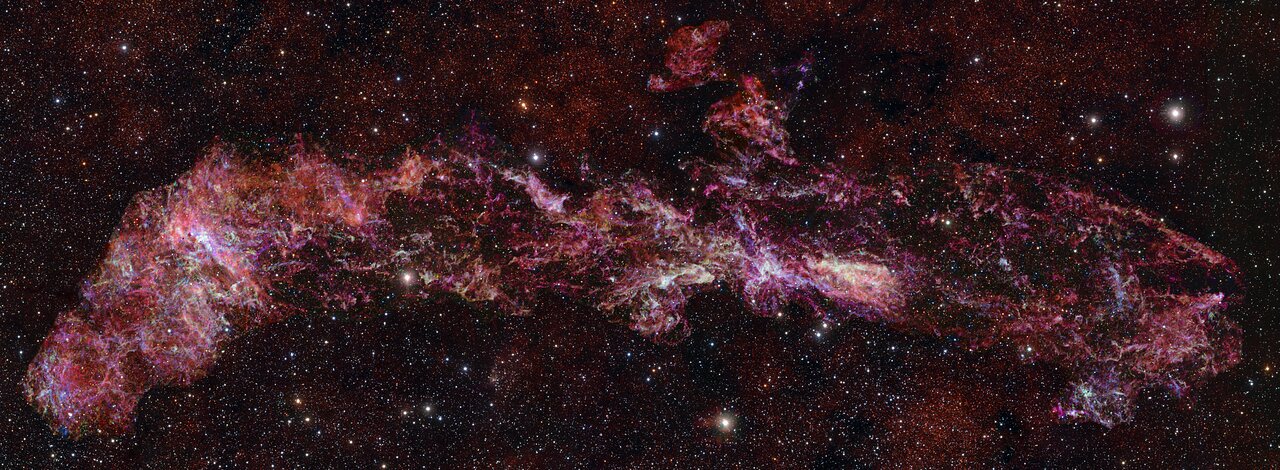
• Press Release Largest image of its kind shows hidden chemistry at the heart of the Milky Way 25 February 2026 Astronomers have captured the central region of our Milky Way in a striking new image, unveiling a complex network of filaments of cosmic gas in unprecedented detail • Obtained with the Atacama Large Millimeter/submillimeter Array (ALMA), this rich dataset - the largest ALMA image to date - will allow astronomers to probe the lives of stars in the most extreme region of our galaxy, next to the supermassive black hole at its centre • “It’s a place of extremes, invisible to our eyes, but now revealed in extraordinary detail,” says Ashley Barnes, an astronomer at the European Southern Observatory (ESO) in Germany who is part of the team that obtained the new data • The observations provide a unique view of the cold gas - the raw material from which stars form - within the so-called Central Molecular Zone (CMZ) of our galaxy • It is the first time the cold gas across this whole region has been explored in such detail • The region featured in the new image spans more than 650 light-years
Article Summaries:
- Press Release Largest image of its kind shows hidden chemistry at the heart of the Milky Way 25 February 2026 Astronomers have captured the central region of our Milky Way in a striking new image, unveiling a complex network of filaments of cosmic gas in unprecedented detail. Obtained with the Atacama Large Millimeter/submillimeter Array (ALMA), this rich dataset - the largest ALMA image to date - will allow astronomers to probe the lives of stars in the most extreme region of our galaxy, next to the supermassive black hole at its centre. “It’s a place of extremes, invisible to our eyes, but n
- Astronomers have captured the central region of our Milky Way in a striking new image, unveiling a complex network of filaments of cosmic gas in unprecedented detail. Obtained with the Atacama Large Millimeter/submillimeter Array (ALMA), this rich dataset-the largest ALMA image to date-will allow astronomers to probe the lives of stars in the most extreme region of our galaxy, next to the supermassive black hole at its center.
Sources:
- https://www.eso.org/public/news/eso2603/
- https://phys.org/news/2026-02-largest-image-kind-hidden-chemistry.html (Latest source article published: 2026-02-25 13:00 UTC)