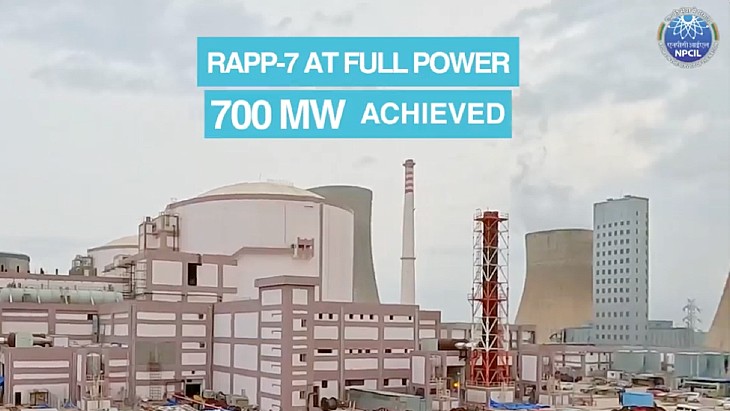
• India’s Rajasthan unit 7 reaches full power Nuclear Power Corporation of India Limited (NPCIL) announced on LinkedIn: “Rajasthan Atomic Power Project - Unit-7 (RAPP-7) successfully achieved rated power operation of 700 MW for the first time on 10 February 2026 at 05.15 hrs. • “The milestone stands as a testament to engineering excellence, strong teamwork and institutional synergy, reinforcing NPCIL’s role in strengthening India’s clean, reliable and self-reliant energy future. • A proud moment for NPCIL, powering India with confidence and excellence.” The company said that the achievement “establishes the robustness of the NPCIL’s 700 MW PHWR design and the capabilities of NPCIL and Indian industries”. • Unit 7 reached first criticality in September 2024 and was connected to the grid in March 2025. • Once a new unit has been connected to the grid, it undergoes a process known as power ascension testing when its power levels are gradually raised - under approval from the regulator - until it reaches full capacity, as unit 7 did on Tuesday. • The unit follows Kakrapar 3 and 4 in a planned fleet of 700 MWe PHWRs: unit 3 achieved first criticality in July 2020, was connected to the grid in January 2021 and was declared to be in commercial operation in July 2023.
Article Summaries:
- India’s Rajasthan unit 7 reaches full power
Nuclear Power Corporation of India Limited (NPCIL) announced that Rajasthan Atomic Power Project - Unit‑7 (RAPP‑7) achieved its rated 700 MW output on 10 February 2026. The unit first reached criticality in September 2024, connected to the grid in March 2025, and underwent power‑ascension testing before attaining full capacity. RAPP‑7 follows Kakrapar 3 and 4, which also reached commercial operation after similar milestones. NPCIL is now advancing the eighth 700 MW unit at Rawatbhata, while the government has approved additional 700 MW plants at Kaiga, Gorakhpur, Chutka and Mahi Banswara. The goal is to reach 100 GW of nuclear capacity by 2047 to support India’s energy transition.
Sources: