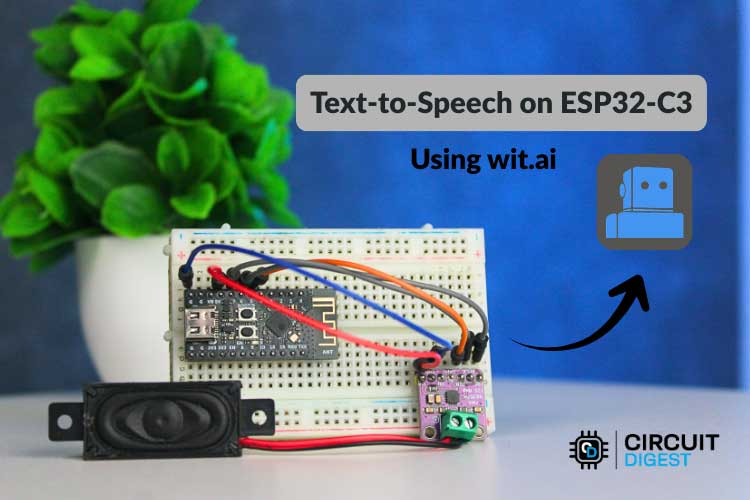
• Text-to-Speech, or TTS, is a technology that converts written text into spoken audio. • It is commonly used in voice assistants, accessibility tools, alert systems, kiosks, and smart devices. • On computers and smartphones, TTS works smoothly because these systems have enough processing power and memory to generate speech locally. • Microcontrollers are different. • They operate with limited speed, limited memory, and no built-in support for advanced audio processing, which makes text-to-speech conversion using esp32 difficult when done directly on the device. • Yet we used a Text-to-Speech Offline library to make the ESP32 Text-to-Speech Offline System using low pre-stored texts.
Article Summaries:
- The guide explains how to add text‑to‑speech (TTS) to an ESP32‑C3 microcontroller using the cloud‑based Wit.ai API. It highlights the ESP32‑C3’s limited processing power, making local TTS impractical, and contrasts offline libraries with the more efficient online approach. By sending text over Wi‑Fi to Wit.ai, the service returns MP3 audio, which the ESP32‑C3 streams to a MAX98357A I²S amplifier and speaker via the WitAITTS Arduino library. The article outlines required hardware, library installation, sketch upload, and troubleshooting, positioning cloud‑based TTS as the practical standard for dynamic speech output on IoT devices.
Sources: