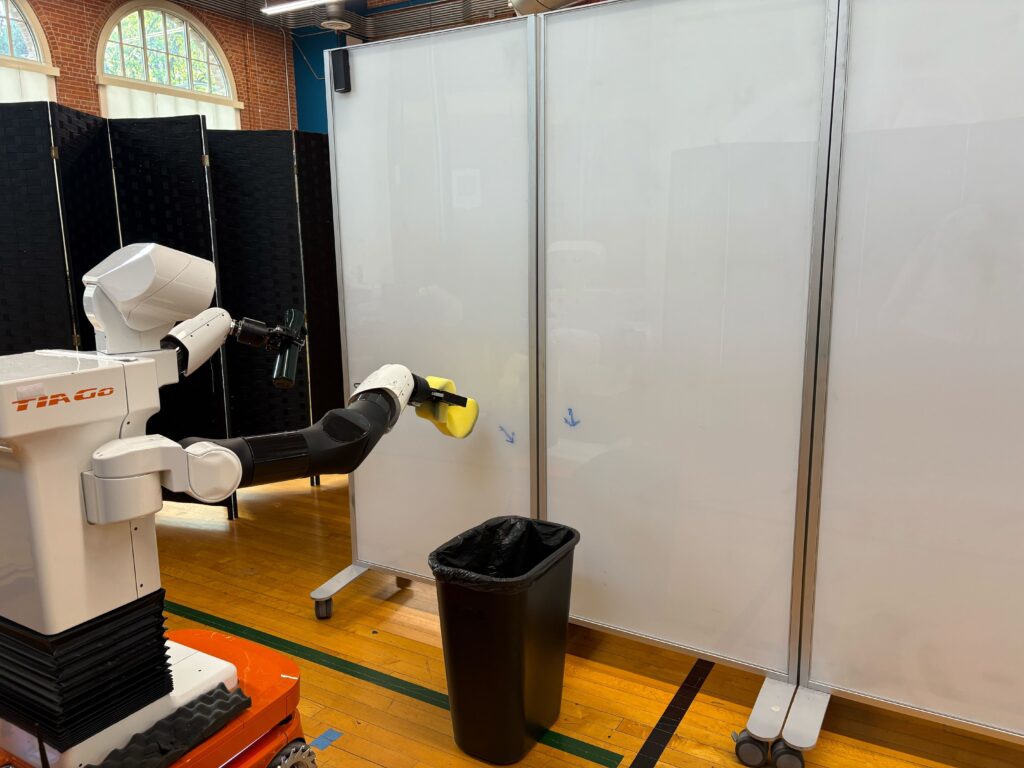
• News Views Podcast Learn team about contribute republish AIhub resources AIhub events News Views Podcast Learn News Views Podcast Learn How can robots acquire skills through interactions with the physical world? • An interview with Jiaheng Hu One of the key challenges in building robots for household or industrial settings is the need to master the control of high-degree-of-freedom systems such as mobile manipulators. • Reinforcement learning has been a promising avenue for acquiring robot control policies, however, scaling to complex systems has proved tricky. • In their workSLAC: Simulation-Pretrained Latent Action Space for Whole-Body Real-World RL,Jiaheng Hu, Peter StoneandRoberto Martín-Martínintroduce a method that renders real-world reinforcement learning feasible for complex embodiments. • We caught up with Jiaheng to find out more. • What is the topic of the research in your paper and why is it an interesting area for study?
Article Summaries:
- Researchers Jiaheng Hu, Peter Stone, and Roberto Martín‑Martín have introduced SLAC (Simulation‑Pretrained Latent Action Space for Whole‑Body Real‑World RL), a two‑step approach that makes reinforcement learning (RL) feasible for complex robots such as mobile manipulators. First, SLAC trains a low‑fidelity simulator to learn a latent action space via unsupervised RL, encouraging safe, task‑agnostic behaviors. Second, the robot uses this latent space as its action set and performs real‑world RL for specific tasks. The method addresses key hurdles-sample inefficiency and safety risks-by reducing reliance on high‑fidelity simulation while still enabling scalable skill acquisition in physical environments.
Sources: