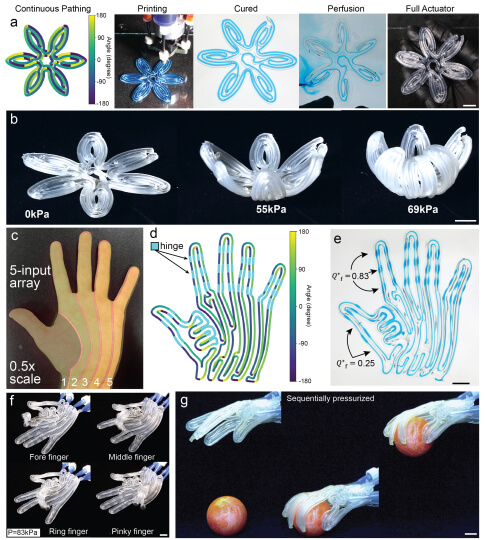
• Harvard SEAS Engineers Develop 3D Printing Method for Soft Robotic Components with Programmable Shapes Share this Article The world of soft robotics is still largely in its pure research phase, butthe R&D landscapehas started to produce examples of early-stage commercialization. • Researchers have started to refine their focus towardsthe genuine advantagesof soft robotics over their more rigid counterparts, and the open-ended design capabilities of additive manufacturing (AM) have been pivotal to this evolution. • Not long ago,researchers from Harvard’s School of Engineering and Applied Sciences(SEAS) published a study inAdvanced Materialsdetailing a novel process they developed, which relies on a rotating printer with a multimaterial nozzle. • Users print a hard polymer shell first, then layer a gel-like polymer on top, resulting in a channel when the shell fully hardens, after which the softer substance is washed away. • Once the end product is inflated, the built-in design (“programmed shapes”) fully emerges, yielding bio-inspired shapes whose production would otherwise require casts and molds. • Some of the example patterns detailed in theAdvanced Materialsarticle include flowers and human hands, addressingone of the most intractable problemsassociated with design for the robotics industry.
Sources: