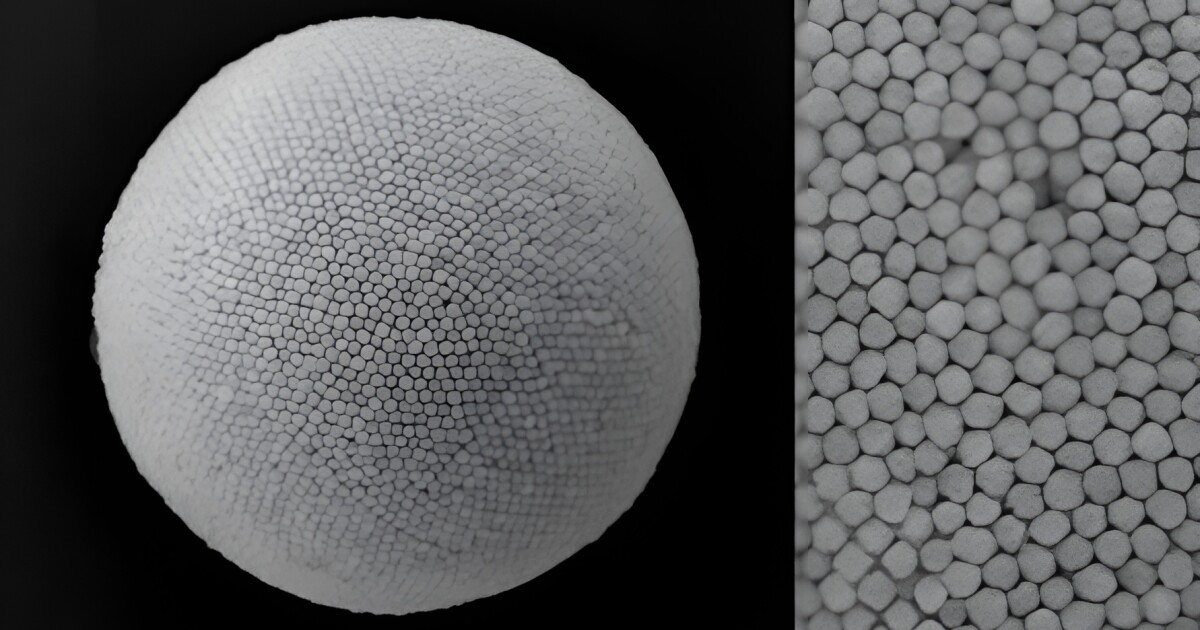
• Gold “supraballs” capture about 90% of the solar spectrum Facebook Twitter LinkedIn Reddit Flipboard Email At any given moment, 89,000 terawatts of solar power hits the Earth’s surface. • While significant advancements have been made in harvesting this power, existing technologies do not capture the full potential of the entire solar spectrum. • This limitation primarily lies in these technologies’ incomplete absorption of the sun’s ultraviolet, visible, and infrared radiation. • A team of researchers at KU-KIST Graduate School of Converging Science and Technology, Seoul, has now reported a way of absorbing nearly the full usable solar spectrum in thermal-based devices, using self-assembling gold nanospheres called plasmonic colloidal supraballs. • Solar radiation spans ultraviolet (3-5%), visible (40-45%), and infrared (50-55%) wavelengths. • Photovoltaic (PV) cells primarily convert visible light and part of the near-infrared spectrum into electricity, leaving much of the remaining energy untapped.
Article Summaries:
- Researchers at KU‑KIST Graduate School in Seoul have developed “plasmonic supraballs,” self‑assembling gold nanospheres that absorb about 90 % of the solar spectrum. The colloidal gold nanoparticles cluster into micrometer‑scale spheres, which are drop‑cast onto ceramic thermoelectric generators to form a textured film. Localized surface plasmon resonances and Mie‑type resonances trap UV, visible, and near‑infrared photons, converting most of the energy into heat. This high absorption boosts the temperature gradient, yielding roughly 2.4 times the power output of conventional nanoparticle coatings. The technology targets thermal‑based solar harvesters such as thermoelectric generators, solar‑thermal collectors, and hybrid PV‑thermal systems.
- Researchers at KU‑KIST in Seoul have developed “plasmonic supraballs” - self‑assembling gold nanospheres that can absorb roughly 90 % of the solar spectrum. The colloidal gold nanoparticles cluster into micrometer‑scale spheres, which are drop‑cast onto ceramic surfaces of thermoelectric generators, forming a textured film that traps ultraviolet, visible and near‑infrared light via localized surface plasmon and Mie resonances. This high absorption boosts thermal energy capture, yielding about 2.4 times the power output of conventional nanoparticle coatings. The technology is aimed at solar‑thermal, thermoelectric, and hybrid PV‑thermal systems, and was reported in ACS Applied Materials & Interfaces.
Sources:
- https://newatlas.com/energy/plasmonic-supraballs-solar-spectrum/ (Latest source article published: 2026-02-24 00:03 UTC)