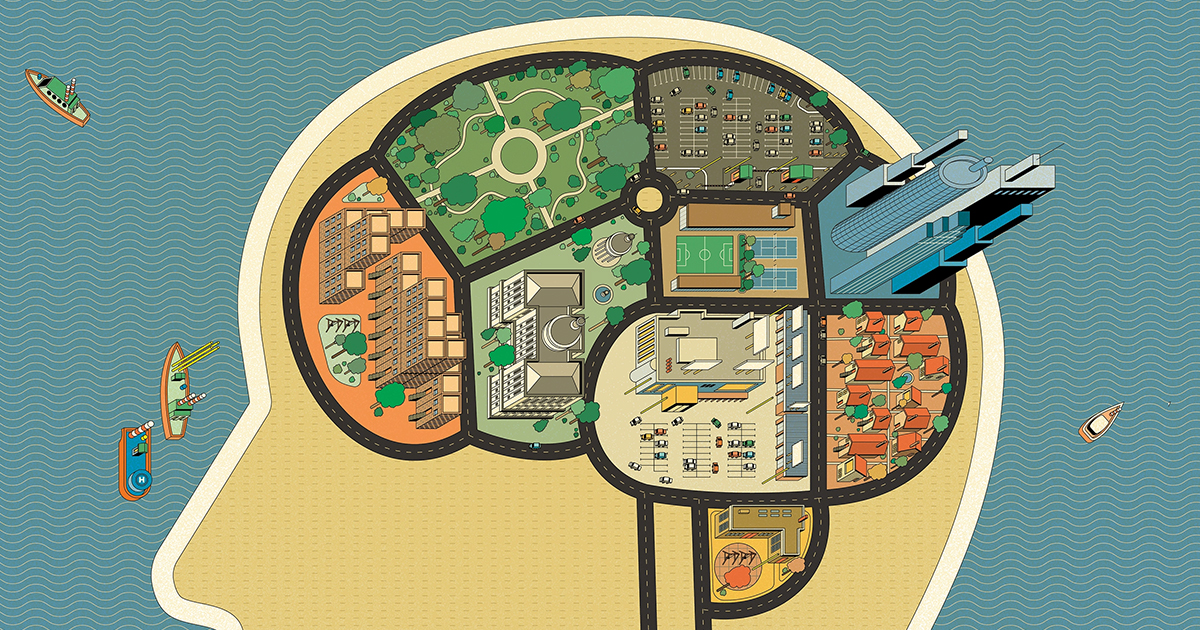
• Fed on Reams of Cell Data, AI Maps New Neighborhoods in the Brain Introduction Real estate agents will tell you that a home’s most important feature is “location, location, location.” It’s similar in neuroscience: “Location is everything in the brain,” said Bosiljka Tasic, a self-described “biological cartographer.” Brain injury in one spot could knock out memory; damage in another could interfere with personality. • Neuroscientists and doctors are lost without a good map. • Researchers have been mapping the brain for more than a century. • By tracing cellular patterns that are visible under a microscope, they’ve created colorful charts and models that delineate regions and have been able to associate them with functions. • In recent years, they’ve added vastly greater detail: They can now go cell by cell and define each one by its internal genetic activity. • But no matter how carefully they slice and how deeply they analyze, their maps of the brain seem incomplete, muddled, inconsistent.
Article Summaries:
- Researchers at the Allen Institute for Brain Science used a custom machine‑learning algorithm to analyze genetic data from 10.4 million cells in five mouse brains. The AI identified previously unrecognized subdivisions within larger brain regions, producing detailed “neighborhood” maps in hours that would have taken humans lifetimes. The study, published in Nature Communications, demonstrates that AI can parse vast single‑cell datasets to refine brain atlases. Scientists plan to apply the method to other species, including humans, to better understand cellular organization and its role in health and disease.
- Researchers at the Allen Institute for Brain Science used machine‑learning to map the mouse brain at unprecedented cellular resolution. By feeding genetic profiles from 10.4 million cells across five mouse brains into a custom algorithm, the team produced detailed maps that identify both known and novel subdivisions within larger brain regions-subdivisions that would take humans years to delineate. The study, published in Nature Communications, demonstrates that AI can rapidly organize vast genetic datasets into coherent 3‑D brain neighborhoods. Scientists hope the approach will extend to other species, including humans, to refine brain atlases and improve understanding of neurological health and disease.
- Researchers at the Allen Institute for Brain Science used a custom machine‑learning algorithm to analyze genetic data from 10.4 million cells in five mouse brains. The AI identified and mapped previously unrecognized subdivisions within larger brain regions, producing a highly detailed “neuro‑real‑estate” map in hours-far faster than manual methods that have taken lifetimes. The study, published in Nature Communications, demonstrates that AI can parse vast single‑cell datasets to reveal finer‑grained brain architecture. Scientists plan to extend the approach to other species and ultimately to humans, aiming to better understand how cellular neighborhoods contribute to brain function and disease.
Sources: