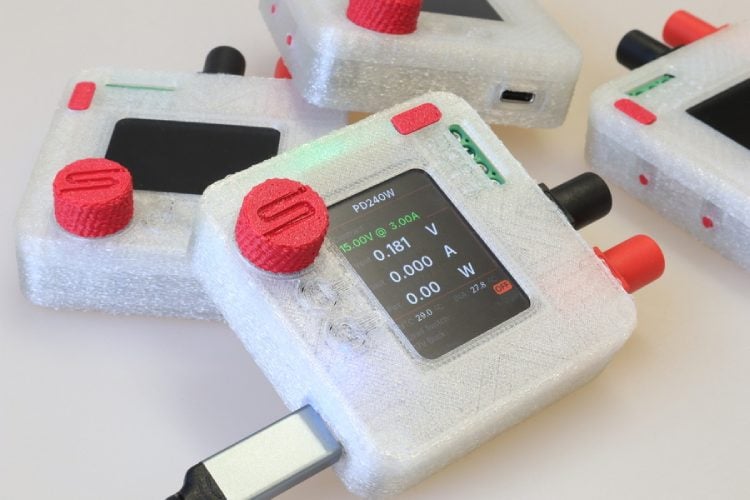
• Bulky bench power supplies and dedicated adapters are still common on electronics workbenches, but they are often inconvenient to carry around and overkill for many portable or field setups. • With USB Power Delivery and newer GaN chargers now able to provide high power from compact adapters, developers are starting to treat USB-C as a serious power source rather than just a charging port. • Theo Heng’sPD240W projectbuilds on this shift by turning a USB-C PD adapter into an adjustable high-power supply suitable for driving motors and other demanding loads. • The compact unit uses a Raspberry Pi RP2040 microcontroller to negotiate power profiles from a USB Power Delivery source, allowing it to request different voltage and current levels depending on the connected charger and the selected mode. • The design supports standard USB PD fixed profiles, PPS (programmable power supply) for finer voltage control in the lower range, and higher-voltage profiles intended for extended power range operation. • In practice, the project has been validated primarily with USB PD 3.0 sources up to 20 V, with higher-voltage operation depending on the capabilities of the connected charger and the user’s own testing.
Article Summaries:
- Bulky bench power supplies and dedicated adapters are still common on electronics workbenches, but they are often inconvenient to carry around and overkill for many portable or field setups. With USB Power Delivery and newer GaN chargers now able to provide high power from compact adapters, developers are starting to treat USB-C as a serious power source rather than just a charging port. Theo Heng’s PD240W project builds on this shift by turning a USB-C PD adapter into an adjustable high-power supply suitable for driving motors and other demanding loads. The compact unit uses a Raspberry Pi RP
Sources:
- https://circuitdigest.com/news/exploring-pd240w-using-usb-power-delivery-as-a-bench-supply-alternative (Latest source article published: 2026-02-25 12:08 UTC)