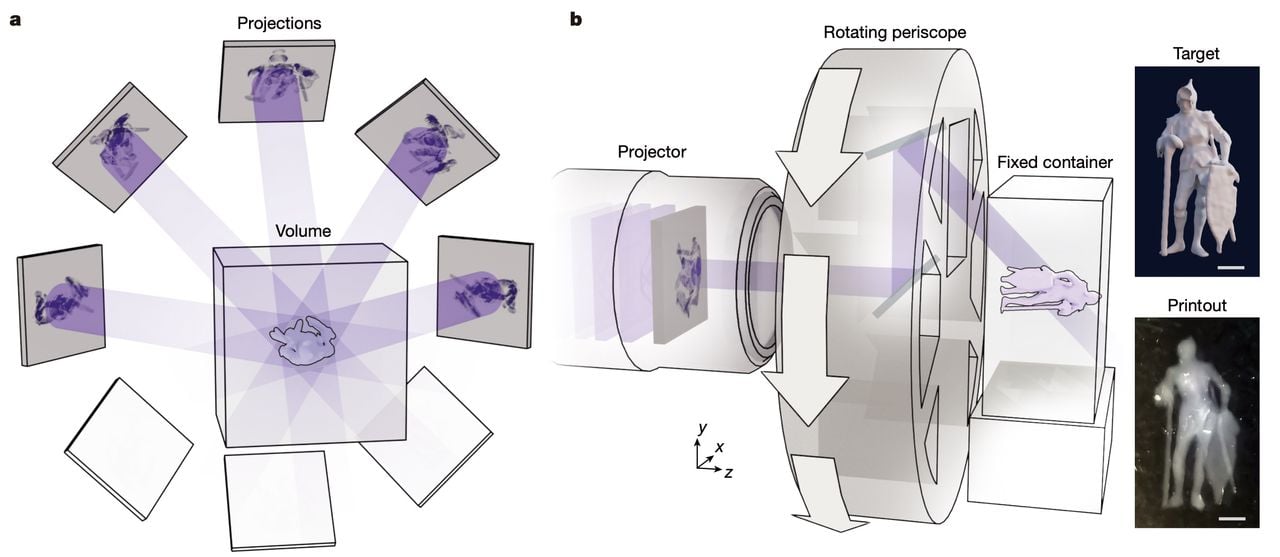
• A Tsinghua University team claims sub second volumetric 3D printing with fine features, and the trick is moving the optics instead of the resin. • Volumetric 3D Printing Keeps Bumping Into Physics Volumetric additive manufacturing has been one of the most interesting alternatives to layer wise photopolymer resin processes including stereolithography, MSLA and DLP. • Instead of stepping through z, approaches like computed axial lithography (CAL) project many angular patterns that sum into a 3D dose distribution, curing an entire volume at once. • But CAL style systems often pay for fidelity with mechanics. • To get enough angular views for tomographic reconstruction, many implementations require rotating the entire resin tank through 360 degrees. • That can make 3D printing awkward, can limit rotation speed due to vibration and alignment drift, and has tended to push users toward higher viscosity resins so the partially cured part does not sink or move during multi second exposures.
Article Summaries:
- Tsinghua University researchers report a breakthrough in volumetric 3D printing, achieving sub‑second fabrication with fine detail. Their method, called DISH (digital incoherent synthesis of holographic light fields), moves a high‑speed rotating periscope in front of a fixed resin tank instead of rotating the entire container. A digital micromirror device (DMD) projects holographic patterns at up to 17 kHz, synchronized with the periscope. The system can print a millimetre‑scale part in 0.6 seconds while maintaining ~19 µm resolution across a 1 cm depth, and operates with low‑viscosity resins (≈4.7 cP). The approach also supports fluidic handling for resin replenishment and part removal.
Sources: