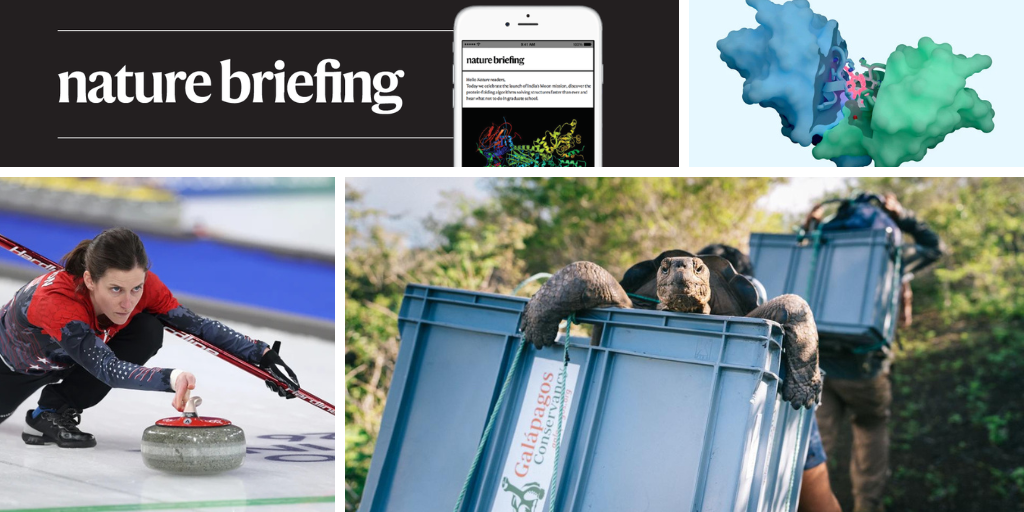
• Email Bluesky Facebook LinkedIn Reddit Whatsapp X You have full access to this article via your institution. • HelloNaturereaders, would you like to get this Briefing in your inbox free every day?Sign up here. • Conservationists used ‘back breeding’ to select for certain genes in hybrid tortoises that might have been the offspring of animals relocated by pirates and whalers in the 1800s. • (© Galápagos Conservancy) Giant tortoises return to Galápagos Conservationists have released 158 giant tortoises on Floreana Island, in the Galapágos archipelago - the first time that tortoisesdescended from the extinct subspeciesChelonoidis niger nigerare walking on their native soil in more than 180 years. • The animals were bred from genetically related tortoises that survived near the remote Wolf Volcano on nearby Isabela Island. • BBC | 4 min read Drug-discovery AI is akin to ‘AlphaFold 4’ Isomorphic Labs - a biopharmaceutical spin-off of Google DeepMind - has unveiled anew, powerful artificial-intelligence tool for predicting how proteinsinteractwith drugs.
Article Summaries:
- Daily briefing: New AI drug‑discovery engine is ‘on the scale of an AlphaFold4’
Isomorphic Labs, a Google DeepMind spin‑off, has launched IsoDDE, an AI system that predicts protein‑drug binding affinities with higher accuracy than existing tools such as Boltz‑2 and physics‑based methods. The proprietary model outperforms competitors on benchmark datasets, but its technical paper offers limited detail on replicating the results. In other news, conservationists released 158 giant tortoises to Galápagos’ Floreana Island, marking the first return of the extinct subspecies in 180 years. Additional highlights include a physics study on curling stones, an AI coach for constructive peer reviews, and a book review on generative biology.
Sources:
- https://www.nature.com/articles/d41586-026-00605-w (Latest source article published: 2026-02-24 13:15 UTC)