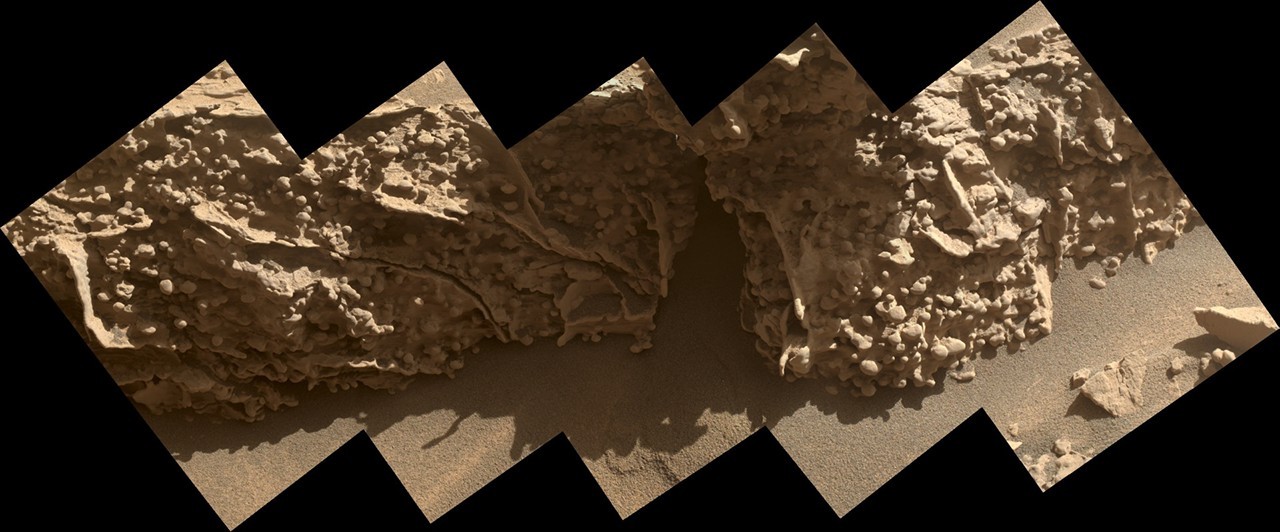
• Curiosity Studies Nodules on Boxwork Formations Downloads Curiosity Studies Nodules on Boxwork Formations JPEG (291.85 KB) PIA26697 Figure A JPEG (291.92 KB) Description NASA’s Curiosity Mars rover discovered these bumpy, pea-sized nodules while exploring a region filled with boxwork formations - low ridges standing roughly 3 to 6 feet (1 to 2 meters) tall with sandy hollows in-between. • This mosaic is made up of 50 individual images taken by Curiosity’s Mars Hand Lens Imager (MAHLI), a camera on the end of the rover’s robotic arm, on Aug. • 21, 2025, the 4,636th Martian day, or sol, of the mission. • Ten images at different focus settings were taken at each of five locations to produce a sharp mosaic. • The images were stitched together after being sent back to Earth. • Figure A is the same image with a small scale bar added to the right-hand side.
Article Summaries:
- NASA’s Curiosity rover has imaged pea‑sized mineral nodules on the ridges of boxwork formations in a Martian outcrop. The 50‑image mosaic, captured on Aug. 21, 2025 (sol 4,636), was assembled from MAHLI photographs taken at five sites with varying focus. The nodules, formed by minerals left as ancient groundwater dried, appear along ridge walls and inter‑ridge hollows rather than near the “central fractures” where groundwater seeped. The surrounding calcium‑sulfate veins further indicate past fluid flow. These findings suggest that groundwater persisted longer than previously thought, prompting new questions about the window for microbial life on Mars.
- NASA’s Curiosity rover has documented pea‑sized nodules on boxwork formations in a Martian region, using 50 images taken by its Mars Hand Lens Imager on Aug. 21, 2025. The mosaic shows ridges 3-6 ft tall with sandy hollows, and the nodules appear along ridge walls and hollows rather than central fractures. The mineral veins, composed of calcium sulfate, indicate past groundwater activity. These findings suggest that groundwater persisted later than previously thought, raising questions about the longevity of microbial life on Mars before surface water disappeared.
- NASA’s Curiosity rover has imaged a field of pea‑sized mineral nodules on the ridged “boxwork” formations of Mars. On Aug. 21, 2025 (sol 4,636), the rover’s MAHLI camera captured 50 images at five sites, each with ten focus settings, stitched into a sharp mosaic. The nodules, formed from minerals left as ancient groundwater dried, appear along ridge walls and in the hollows between ridges-not near the central fractures where seepage originally occurred. The calcium‑sulfate veins that create the wavy ridges suggest continued groundwater activity later than previously thought, prompting new questions about the longevity of potential microbial life on Mars.
- Description NASA’s Curiosity Mars rover discovered these bumpy, pea-sized nodules while exploring a region filled with boxwork formations - low ridges standing roughly 3 to 6 feet (1 to 2 meters) tall with sandy hollows in-between. This mosaic is made up of 50 individual images taken by Curiosity’s Mars Hand Lens Imager (MAHLI), a camera on the end of the rover’s robotic arm, on Aug. 21, 2025, the 4,636th Martian day, or sol, of the mission. Ten images at different focus settings were taken at each of five locations to produce a sharp mosaic. The images were stitched together after being sent
Sources:
- https://science.nasa.gov/photojournal/curiosity-studies-nodules-on-boxwork-formations/ (Latest source article published: 2026-02-23 17:58 UTC)