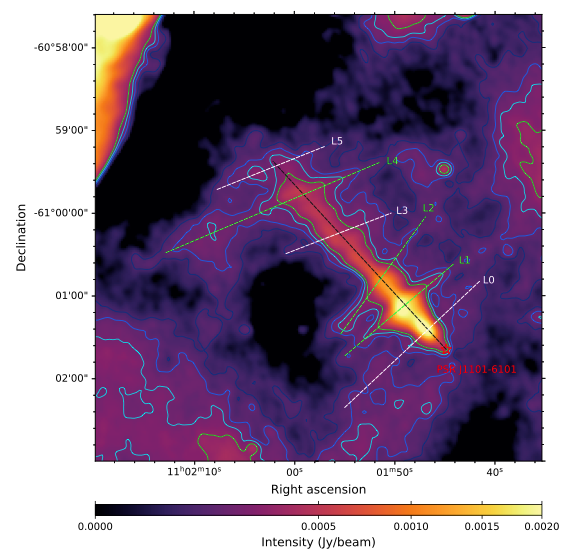
• Cosmic Fishbones: Strange Radio Streaks Behind a Racing Pulsar bySandy Chiu| Feb 21, 2026 |Daily Paper Summaries|0 comments Title:Radio streaks in the Lighthouse Nebula discovered with MeerKAT - Particles escaping from the tail and illuminating the ambient magnetic fieldAuthors: Pierrick Martin, Mickael Coriat, Barbara Olmi, Elena Amato, Niccolò Bucciantini, Alexandre Marcowith, Sarah RecchiaFirst Author’s Institution: IRAP, Université de Toulouse, CNRS, CNES, F-31028 Toulouse, FranceStatus: Submitted to A&A (available on Arxiv) Pulsarsare rapidly spinning, highly magnetizedneutron stars, the dense remnants left behind after massive stars explode. • As they spin down, pulsars release their rotational energy into their surroundings, inflating bright structures calledpulsar wind nebulae (PWNe). • In these nebulae, powerful shocks heat the surrounding gas and accelerate particles like electrons and protons to extreme energies, turning them intocosmic rays. • These energetic particles do not keep their energy forever. • As they travel, they lose energy through radiation processes such assynchrotron emission(when charged particles spiral around magnetic field lines) andinverse-Compton scattering(when particles transfer energy to low-energy photons). • Fortunately for astronomers, these radiation processes make cosmic rays visible, allowing us to trace how energy from pulsars is transported into their environments.
Article Summaries:
- Title: Radio streaks in the Lighthouse Nebula discovered with MeerKAT - Particles escaping from the tail and illuminating the ambient magnetic field Authors: Pierrick Martin, Mickael Coriat, Barbara Olmi, Elena Amato, Niccolò Bucciantini, Alexandre Marcowith, Sarah Recchia First Author’s Institution: IRAP, Université de Toulouse, CNRS, CNES, F-31028 Toulouse, France Status: Submitted to A&A (available on Arxiv) Pulsars are rapidly spinning, highly magnetized neutron stars, the dense remnants left behind after massive stars explode. As they spin down, pulsars release their rotational energy int
Sources:
- https://astrobites.org/2026/02/21/cosmic-fishbones/ (Latest source article published: 2026-02-21 18:29 UTC)