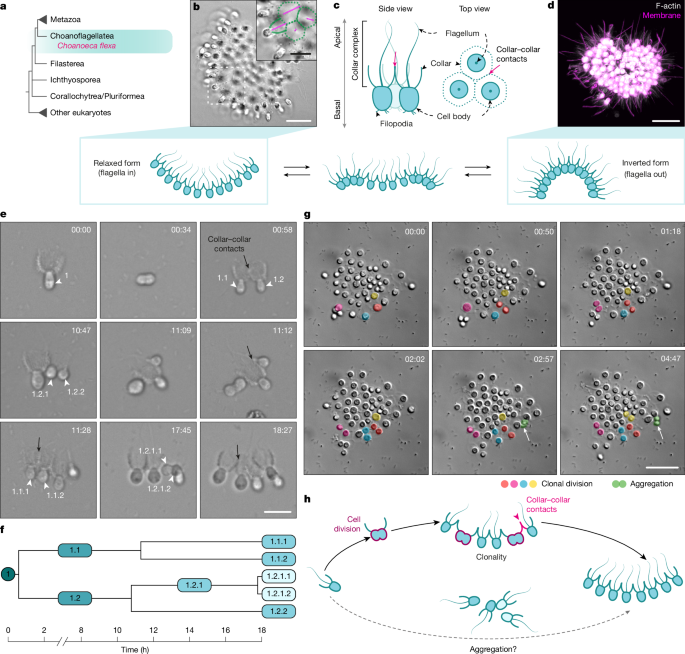
• Abstract Multicellularity evolved independently multiple times in eukaryotes1,2,3,4 • Two distinct mechanisms underpin multicellularity5: clonality (serial cell division without sister-cell separation) and aggregation (whereby independent cells assemble into a multicellular entity) • Clonal and aggregative multicellularity are traditionally considered to be mutually exclusive1,6,7,8, with rare exceptions9, and evolutionary hypotheses have addressed why multicellularity might diverge towards one or the other extreme3,4 • Both animals and their sister group, the choanoflagellates, are currently known to acquire multicellularity only clonally4,10,11 • Here we show that the choanoflagellate Choanoeca flexa12 forms motile and contractile cell monolayers (sheets) through multiple mechanisms-C • flexa sheets can form purely clonally, purely aggregatively or through a combination of both processes
Article Summaries:
- Abstract Multicellularity evolved independently multiple times in eukaryotes1,2,3,4. Two distinct mechanisms underpin multicellularity5: clonality (serial cell division without sister-cell separation) and aggregation (whereby independent cells assemble into a multicellular entity). Clonal and aggregative multicellularity are traditionally considered to be mutually exclusive1,6,7,8, with rare exceptions9, and evolutionary hypotheses have addressed why multicellularity might diverge towards one or the other extreme3,4. Both animals and their sister group, the choanoflagellates, are currently kno
Sources:
- https://www.nature.com/articles/s41586-026-10137-y (Latest source article published: 2026-02-25 17:32 UTC)