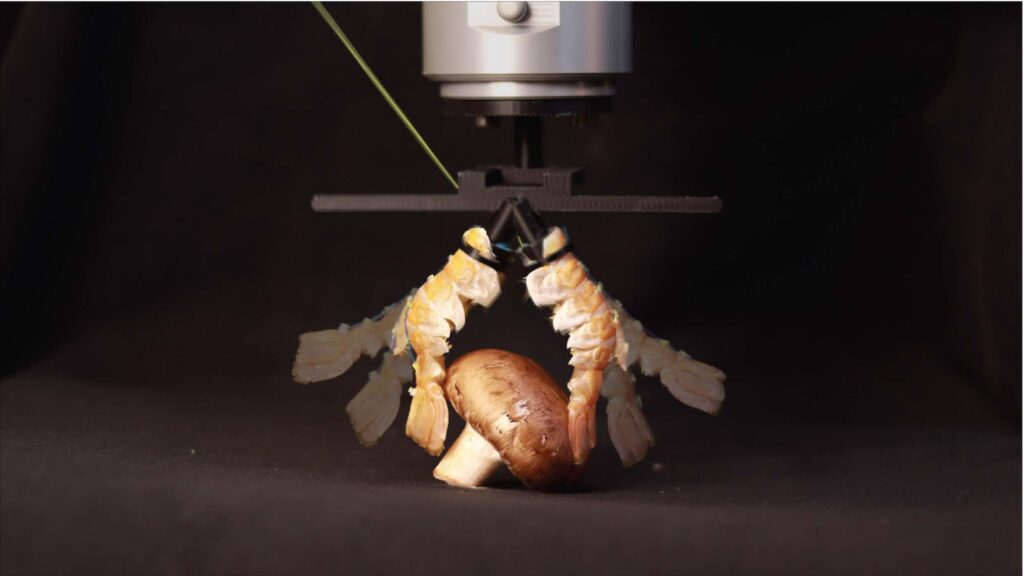
• News Views Podcast Learn team about contribute republish AIhub resources AIhub events News Views Podcast Learn News Views Podcast Learn Bio-hybrid robots turn food waste into functional machines Demonstration of the robotic gripper made from langoustine tails. • 2025 CREATE Lab EPFL CC BY SA. • By Celia Luterbacher Although many roboticists today turn to nature to inspire their designs, evenbioinspired robotsare usually fabricated from non-biological materials like metal, plastic and composites. • But a new experimental robotic manipulator from the Computational Robot Design and Fabrication Lab (CREATELab) in EPFL’s School of Engineering turns this trend on its head: its main feature is a pair of langoustine abdomen exoskeletons. • Although it may look unusual, CREATE Lab head Josie Hughes explains that combining biological elements with synthetic components holds significant potential not only to enhance robotics, but also to support sustainable technology systems. • “Exoskeletons combine mineralized shells with joint membranes, providing a balance of rigidity and flexibility that allows their segments to move independently.
Article Summaries:
- EPFL’s CREATE Lab has built a proof‑of‑concept robotic system that repurposes langoustine tails-food‑industry waste-into functional components. By embedding elastomer inside the crustacean exoskeletons, mounting them on a motorized base, and coating them with silicon, the team created a manipulator that can lift up to 500 g, a two‑finger gripper that can grasp objects from pens to tomatoes, and a swimming robot that flaps at 11 cm/s. The synthetic parts can be largely reused after disassembly, offering a sustainable, cyclic design. Variability in tail shape limits consistency, prompting plans for tunable controllers and future applications in biomedical and monitoring devices.
Sources: