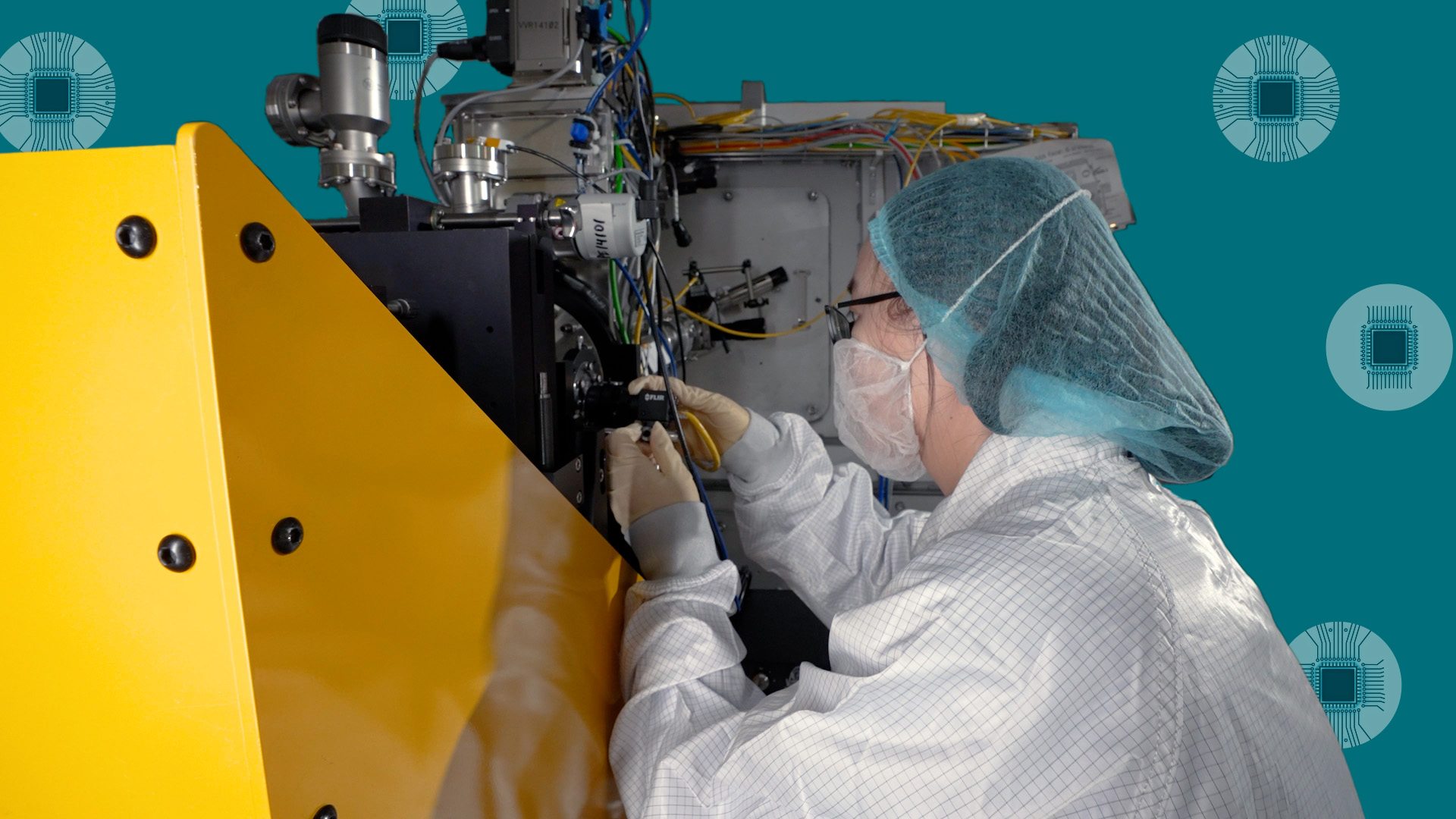
• Basics 2 Breakthroughs: Optimizing Materials for Next-Generation Microelectronics Video Microelectronics The tiny microchips that power modern technologies are already an impressive feat but materials research scientist Qi Zhang seeks to push the boundaries even further. • As part of the Center for X-Ray Optics, powered by the Advanced Light Source at Berkeley Lab, Zhang is studying the fundamental properties of the materials used to design and build microchips. • Her work will help create products that are smaller, faster, and more efficient. • Microelectronics Materials Article Microelectronics Compute This: Six Ways Berkeley Lab is Shaping the Future of Microelectronics Video Microelectronics Science Power-up: The Most Exciting Thing in Microelectronics Video Accelerators Basics 2 Breakthroughs: Studying the Hydraulic Mechanism in Jumping Spiders
Basics 2 Breakthroughs: Optimizing Materials for Next-Generation Microelectronics Video Microelectronics The tiny microchips that power modern technologies are already an impressive feat but materials research scientist Qi Zhang seeks to push the boundaries even further. • As part of the Center for X-Ray Optics, powered by the Advanced Light Source at Berkeley Lab, Zhang is studying the fundamental properties of the materials used to design and build microchips. • Her work will help create products that are smaller, faster, and more efficient.
Article Summaries:
- Materials researcher Qi Zhang at the Center for X‑Ray Optics, part of the Advanced Light Source at Lawrence Berkeley National Laboratory, is investigating the fundamental properties of the materials that form modern microchips. By probing how these materials behave at the atomic level, Zhang aims to identify ways to improve their performance and reliability. The goal is to enable the next generation of microelectronics that are smaller, faster, and more energy‑efficient. The work builds on the existing success of microchips while seeking to push the limits of size, speed, and efficiency in future devices.
- Researchers at Berkeley Lab’s Center for X‑Ray Optics are advancing microelectronics by probing the fundamental properties of chip‑making materials. Qi Zhang uses the Advanced Light Source to study how these materials behave at the atomic level, aiming to identify compositions and structures that can support smaller, faster, and more energy‑efficient devices. The work seeks to push the limits of current microchip performance, potentially enabling next‑generation electronics with higher speed and lower power consumption. This effort represents a key step toward more compact and efficient semiconductor technologies.
Sources:
- https://newscenter.lbl.gov/2026/02/23/basics-2-breakthroughs-optimizing-materials-for-next-generation-microelectronics/ (Latest source article published: 2026-02-23 17:00 UTC)