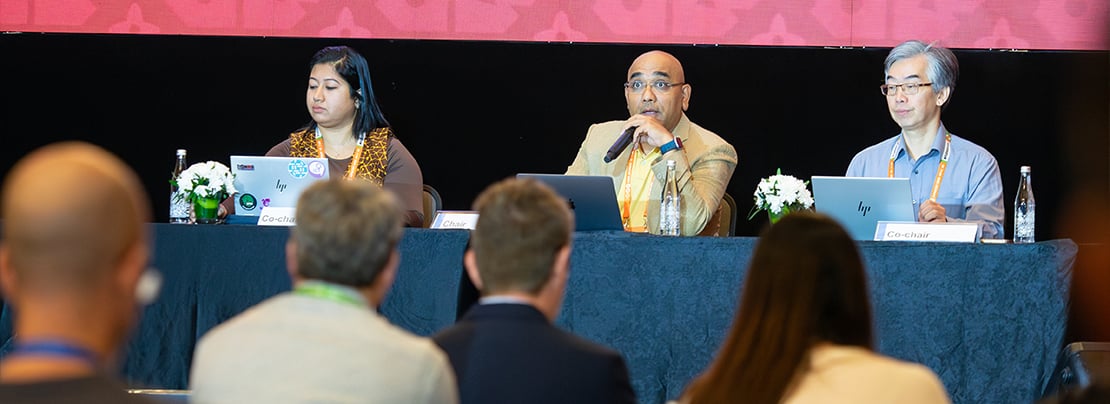
• The APNICOpen Policy Meeting (OPM)held during the Policy Special Interest Group (Policy SIG) session at APNIC 61 in Jakarta brought together the Asia Pacific Internet community to discuss Internet number resource management and explore how policies can support both small and large network operators. • The session was chaired by Bikram Shrestha, with Co-Chairs Shaila Sharmin and Ching-Heng Ku, and had secretariat support from APNIC Policy Manager and Senior Network Analyst Dave Phelan. • APNIC policies are created through a bottom-up, transparent, and inclusiveprocess. • Discussions are recorded and considered through mailing lists and formal meetings, and new Members are invited to subscribe to the mailing list to follow proposals and engage in the conversation. • prop-164: Allocations of IPv6 Resources longer than a /32 with a nibble boundary alignment One of the main topics wasprop-164, put forward by Christopher Hawker and Luke Thompson, which suggested reducing the minimum IPv6 allocation from a /32 to a /36. • The authors noted that the idea was to help smaller operators and businesses request address blocks that matched their operational needs, avoiding unnecessary over-allocation that can lead to inaccurate whois records.
Article Summaries:
- APNIC 61’s Policy SIG session in Jakarta focused on Internet number resource management, with two key proposals debated. Prop‑164, submitted by Christopher Hawker and Luke Thompson, would lower the minimum IPv6 allocation from a /32 to a /36 to better suit small operators, though concerns were raised about long‑term routing aggregation for larger networks. Prop‑168, also by Hawker, proposes raising the maximum IPv4 delegation to a /22 and reserving a /12 pool for new members to aid IPv4‑to‑IPv6 transition, while a five‑year transfer lock would limit abuse. No consensus was reached; discussions continue on the mailing list.
- The APNIC Open Policy Meeting (OPM) held during the Policy Special Interest Group (Policy SIG) session at APNIC 61 in Jakarta brought together the Asia Pacific Internet community to discuss Internet number resource management and explore how policies can support both small and large network operators. The session was chaired by Bikram Shrestha, with Co-Chairs Shaila Sharmin and Ching-Heng Ku, and had secretariat support from APNIC Policy Manager and Senior Network Analyst Dave Phelan. APNIC policies are created through a bottom-up, transparent, and inclusive process. Discussions are recorded a
Sources:
- https://blog.apnic.net/2026/02/24/balancing-growth-and-efficiency-apnic-61-policy-sig-deliberations-on-ipv6-and-ipv4-allocation/ (Latest source article published: 2026-02-24 05:14 UTC)