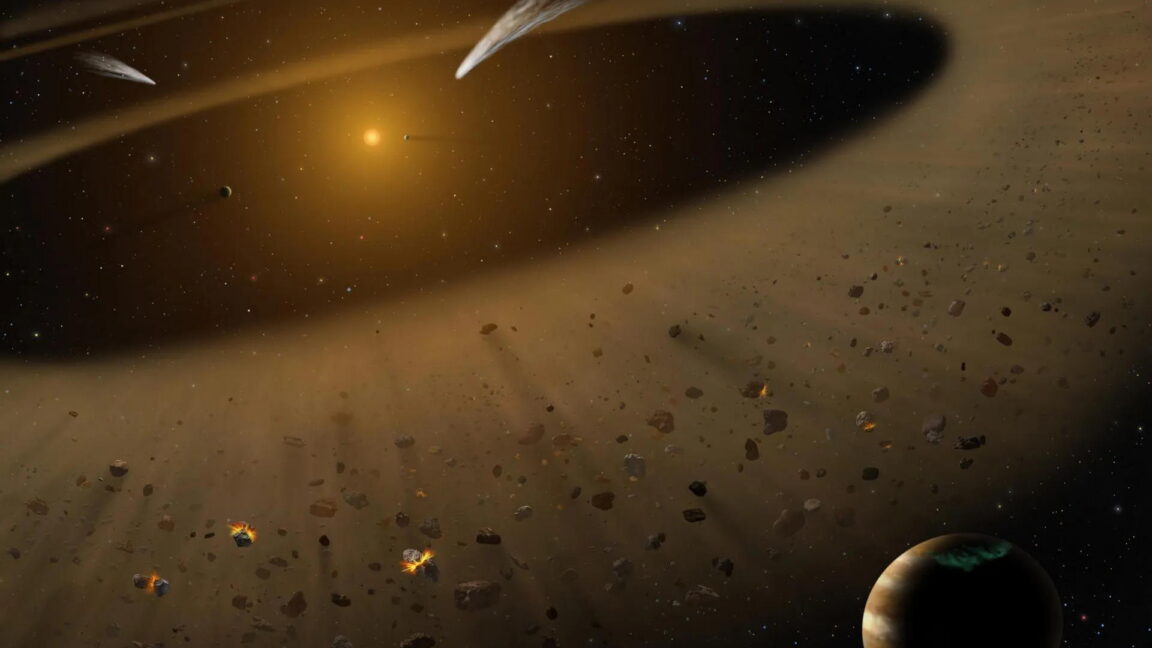
• Kuiper Belt: ring of icy relics beyond Neptune, 30‑50 AU from Sun. • 4,000 KBOs cataloged; expected to grow tenfold with Vera Rubin Observatory’s LSST. • LSST and JWST will map the belt, filling gaps in current patchwork surveys. • Researchers seek hidden planets, belt’s extent, and evidence of past cataclysmic encounters. • New data may reveal unseen planetary bodies and refine solar system formation models. • Astronomers anticipate a flood of discoveries reshaping our understanding of the outer solar system.
Article Summaries:
- Out beyond the orbit of Neptune lies an expansive ring of ancient relics, dynamical enigmas, and possibly a hidden planet-or two. The Kuiper Belt, a region of frozen debris about 30 to 50 times farther from the sun than the Earth is-and perhaps farther, though nobody knows-has been shrouded in mystery since it first came into view in the 1990s. Over the past 30 years, astronomers have cataloged about 4,000 Kuiper Belt objects (KBOs), including a smattering of dwarf worlds, icy comets, and leftover planet parts. But that number is expected to increase tenfold in the coming years as observations
- Astronomers are poised to dramatically expand the catalog of Kuiper Belt objects (KBOs) as new surveys begin. Since the 1990s, about 4,000 KBOs have been identified, but the Vera C. Rubin Observatory’s Legacy Survey of Space and Time (LSST) and the James Webb Space Telescope (JWST) are expected to increase this number tenfold in the coming years. The LSST will provide a comprehensive, uniform survey of the outer solar system, filling gaps left by earlier patchwork observations. This influx of data may reveal previously unseen planets, clarify the belt’s outer limits, and uncover evidence of past planetary encounters.
Sources: