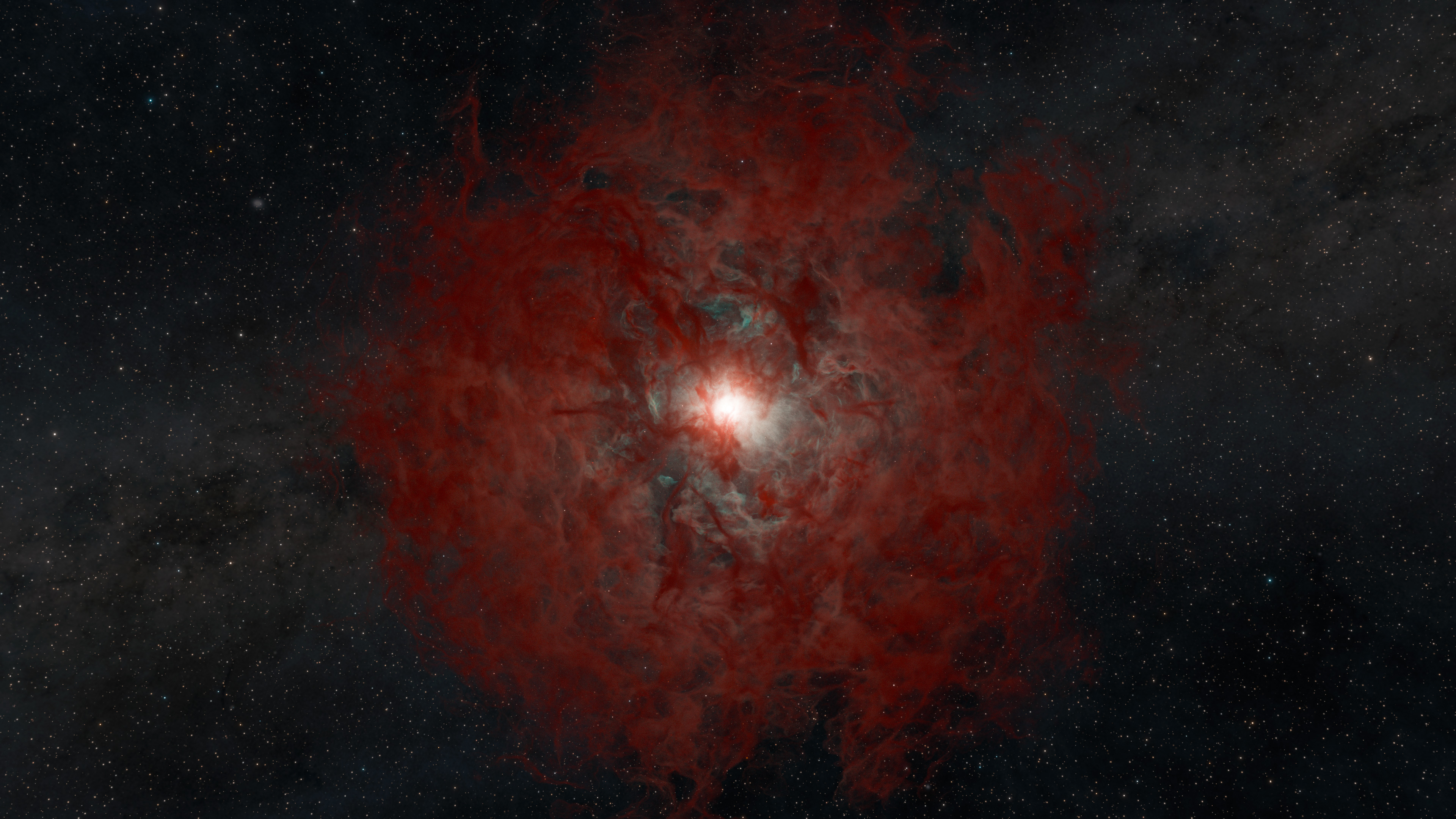
• Archival Data From NASA’s NEOWISE Tracks Star Turning Into Black Hole This artist’s concept shows a thick shell of gas and dust that has been expelled from a massive star’s outer layers as its core collapses after running out of fuel. • At the center, a hot, dense ball of gas continues to fall inward, feeding the newly formed black hole. • Researchers used data from the now-retired spacecraft and other space and ground-based observatories helped to piece together the mystery of a ‘failed’ supernova. • Massive stars are often known to go out with a bang: The core collapses, and a wave of subatomic particles called neutrinos erupt outward, causing the star to explode as a supernova that can outshine an entire galaxy. • But 2.5 million light-years away from Earth, in the Andromeda galaxy, a dying star named M31-2014-DS1 did something unusual and it was captured by a NASA telescope. • Rather than exploding, the star blinked out, leaving behind a shroud of hot gas and dust - and something else.
Article Summaries:
- NASA researchers used archival data from the NEOWISE infrared survey, combined with observations from 2005‑2023, to study the massive star M31‑2014‑DS1 in the Andromeda galaxy. In 2014 the star brightened in infrared, then by 2023 its visible light had dimmed by more than 10,000 times. The team interprets this as a “failed” supernova: the star shed its outer layers, but the core collapsed without a powerful shockwave, forming a black hole and leaving a shroud of hot gas and dust. The study, published in Science, also identifies a second candidate, suggesting a common quiet collapse pathway for black hole formation.
Sources: