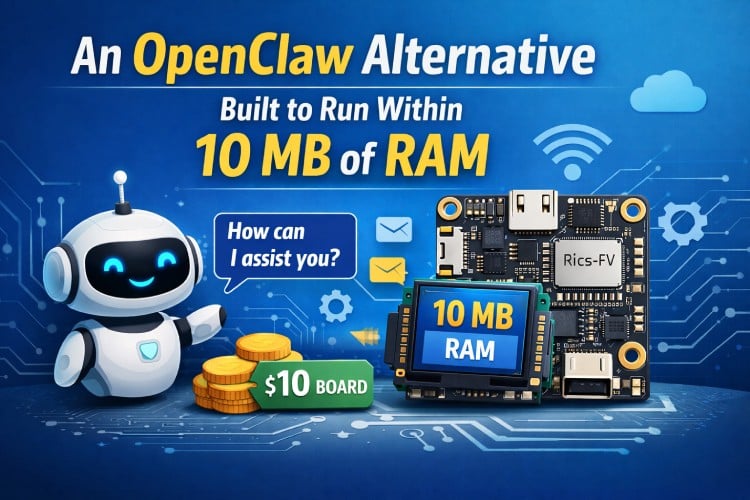
• Open-source personalAI assistantssuch as OpenClaw have shown how task automation can be integrated with everyday chat platforms, but they usually assume desktop- or server-class hardware. • PicoClaw, a new project from Sipeed, targets a different class of devices by focusing on very low memory usage and simple deployment on small Linux boards. • It is positioned as a lightweight alternative for developers who want to experiment with assistant-style workflows on low-cost embedded systems rather than full PCs. • According to the project documentation, PicoClaw is designed to run in under 10 MB of RAM, which makes it suitable for entry-level single-board computers and embedded Linux platforms, including low-cost RISC-V boards. • This is a significant reduction compared to OpenClaw, which typically requires far more memory and storage to run comfortably. • The software is distributed as a single binary for common architectures such as RISC-V, ARM64, and x86-64, which simplifies deployment and testing across different development boards.
Article Summaries:
- Open-source personal AI assistants such as OpenClaw have shown how task automation can be integrated with everyday chat platforms, but they usually assume desktop- or server-class hardware. PicoClaw, a new project from Sipeed, targets a different class of devices by focusing on very low memory usage and simple deployment on small Linux boards. It is positioned as a lightweight alternative for developers who want to experiment with assistant-style workflows on low-cost embedded systems rather than full PCs. According to the project documentation, PicoClaw is designed to run in under 10 MB of RA
Sources: